


Clubs and RSLs have employees who stay for decades, finding a workplace which acts like a family, not just for them, but also for patrons.
Denise Stark can remember exactly when she started working as a ‘bunny girl’ at The Juniors Group of Clubs. It was 7 February, 1970, just after her daughter turned one. The club was – and still is – the supporting ‘juniors’ arm for the South Sydney Rabbitohs, and 1970 was part of the ‘golden era’ of premierships. That July, Souths went on to beat Manly Warringah in the grand final, with the likes of legends John Sattler and Ron Coote playing on the field.
It was such a significant final because Sattler broke his jaw in the early stages of the game, hiding injury so the committed captain could help his team win. Immortalised by The Whitlams in their 2022 song, The Day John Sattler Broke His Jaw, the song epitomises the importance of rugby league for the working classes that dominated the inner city at that time.
Juniors has been like a ‘second family’ to Denise, supporting her over 56 years through thick and thin, particularly after the death of her husband Gary two years ago. “After I lost him, I lost all my confidence,” Denise, 76, recalls. Colleagues she calls friends stepped in to cover her shifts, allowing her time to recover. “I couldn’t speak more highly of what they did for me,” recalls Denise. Reflecting on her 56 years at the club, Denise says: “It doesn’t seem that long now. But through the years when you’re working and raising your family and you’re so busy, you just do it, don’t you? But now I look back and I think, ‘Wow, it’s been a really lovely journey.’”
That journey for Denise started in the gaming room as a bunny girl, wearing a beautiful uniform complete with hat, and paying out jackpots on the poker machines. After that, Denise transitioned to the bar, training staff and organising functions. All these years later, now living with Parkinson’s, she still works one day a week doing bingo. A stalwart activity for all clubs across Sydney, the Kingsford branch offers bingo four days a week. She still remembers the calls: ‘legs eleven and 22, two little ducks!’
Denise says members mostly enjoy the socialising which happens at the club. “I just think it’s friendship, being together, getting out of the house. There’s a lot of things that the members can come to the club for.”
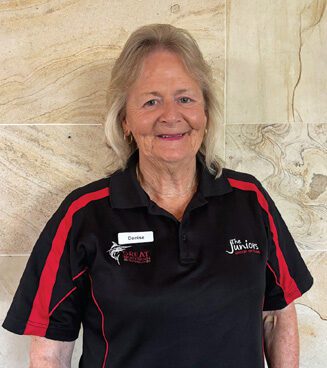
Denise Stark from The Juniors
The lasting friendships with colleagues has been a highlight, Denise says. “We have a lot of fun!”
Denise is one of five club employees interviewed for this story about their longevity working in clubs. It’s a common theme across NSW, with quite a few club CEOs having worked their way up from bottom to top, using decades of experience and training to create continuity in the workplace.
Seven Hills RSL CEO Joe Bayssari has been at the Western Sydney club for 30 years. He says that 21% of employees have worked there for more than 10 years, creating a ‘stable workforce.’ “Long term employees are important for sustaining business growth, providing continuity and growing a positive culture within the club,” Joe says. “They have a wealth of knowledge about the business, and strong connections with customers which in turn increases customer loyalty.”
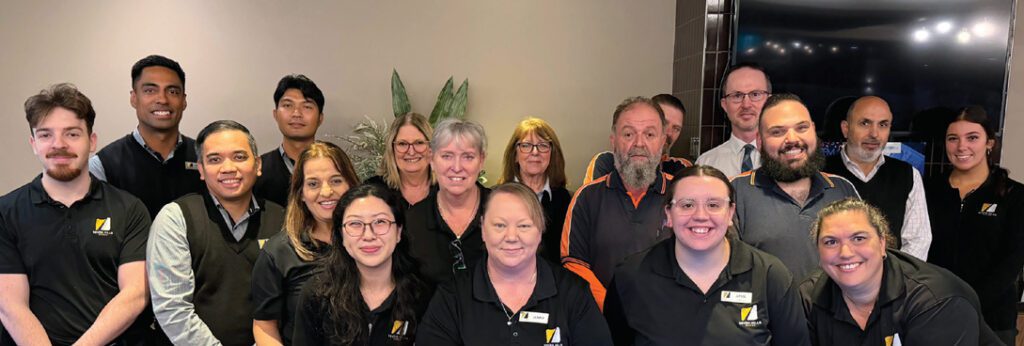
‘Long term employees are the backbone of a business’s long term success:’ Joe Bayssari (second from right) with Seven Hills staff
They also play an important role in training new staff, proving good team morale and mentoring, the CEO says. “Long term employees are the backbone of a business’s long term success. We are nothing without our staff.”
Sue Stride and Sharon Strong have both worked at Seven Hills RSL for over 30 years, forming ‘a beautiful friendship.’ “Their long term loyalty is a true commitment to the club and everything it stands for,” says group marketing manager Jessica Chen. “What makes their story even more meaningful is that they met here at the club all those years ago and have since formed a beautiful friendship. Both of them get along like peas in a pod – always laughing, and are cherished by staff and members alike.”
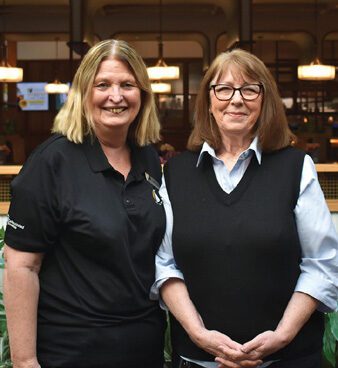
Sharon Strong and Sue Stride have been friends and colleagues for over 30 years
Sue recalls starting 34 years ago as the CEO’s secretary, back in the days of the typewriter. She has looked after three general managers and seen many changes, with Seven Hills growing from just one club into the four clubs of today. Now 72 and well past retirement age, Sue still works two and a half days in the office. “I don’t want to retire because I think I’ll go nuts, and I’ve got to keep this brain working!” she laughs.
Contact with her beloved members is also important, she says. “I’ve known so many of them for so long. We’ve got Ray and Mary that come here every Tuesday. He’s 98, she’s 87 and they’re just fun. I love talking to them every week.
“A lot of our members that come in during the day, especially the bingo ladies, they’re older, and I think it’s really important to them that we forge friendships with them, and they all make friends with each other. Even though we’re still really big, we’re still a happy family.”
A linking theme for the employees Club Living spoke to is the ability to work in so many different parts of a club – including hospitality, gaming, front of house and events. Joe Bayssari says at Seven Hills, all employees are offered pathways for future development. “We are proud that our current supervisors and managers have all been promoted from within our existing staff.”
Sharon Strong started at Seven Hills 39 years ago washing glasses, and eventually went into the club house to help with bingo, moving into bar work and reception. “I think I’ve done nearly everything in the club!” she jokes. Chatting to customers has always been a highlight, providing a vital social service too. “I think the majority of my customers I have come because they’re old and they’re lonely. I’d like to think I’ve made a difference in their lives.
“A lot of people tell me they love coming to this club because we are really friendly, a nice bunch of people, so that’s nice to get feedback like that.” For Joe, after 30 years working at Seven Hills, ‘no two days are ever the same.’
“I enjoy the challenges of the ever-changing club industry. Mentoring staff and managers is also very rewarding, as well as providing our customers with the best facilities that we can.”
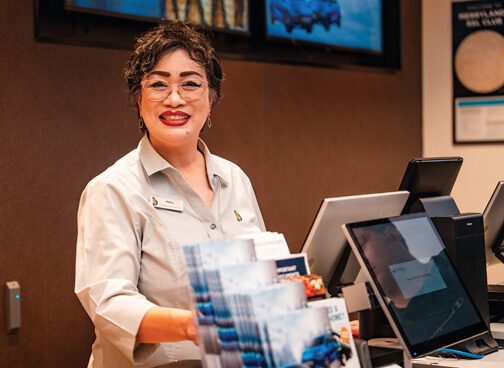
THE STORY OF CHERRY SISON, 38 YEARS AT MERRYLANDS RSL, CUSTOMER SERVICE SUPERVISOR
“I arrived in Australia on 6 December, 1987 from The Philippines and after five days, I started to work as a casual at Merrylands RSL. I was 20 when I came in. I’m 59 now. I was studying at TAFE and waitressing in the old bistro to earn a bit of money. I was part of that (migrant) generation that was working, studying, part of starting up in a different country.
We’d come to Australia because my mum was working for Philippines Airlines and had a friend who asked her to come over.
After six months, they asked me to be full time. So I was waitressing, then a cashier, and later on, I became a helper in the kitchen. And in fact, I wasn’t a chef, but I was cooking! My grandma was a cook, so I learned here and there, and then they taught me how to cook steaks – rare, blue, medium, well done.
After five years someone asked me ‘Would you like to work on reception?’ They had heard me using the microphone in the bistro (and thought I was good!). I knew how to do electric typing as I had done a junior secretarial course.
Then I worked in gaming, at the change counter, and got to meet many people there. I loved the customers there. At first I was a bit shy, but now I’m very talkative, and I make jokes. I’m always friendly, but that’s my nature – it’s not because that’s my job.
Merrylands RSL is like a family to me. Sometimes when people ask me (why I’m still here), I say ‘They adopted me when I was young, that’s why I’m still here!’
My best memories are the people who always say ‘Hello Cherry!’ and give me something for Christmas. It’s just beautiful, you get to know them, they share their life with you and that’s what I really love at the club.
The staff and the management have become like my family, as my parents passed away when I was little. They don’t treat you just like a staff member – they treat you like family.”