


Community calls for education and enforcement to address harmful activity on dunes
“Keep off the dunes, dudes,” urged Northern Beaches Greens councillor Kristyn Glanville, who raised a successful motion to address dune vandalism at the July council meeting.
Council will now look into developing an awareness campaign to prevent and respond to dune vandalism, noting the prevalence of parties which have resulted in destroyed vegetation and litter left behind.
Cr Glanville said the motion came about due to the ongoing efforts of community volunteers who have put the spotlight on the impacts of dune activity.
“We have volunteers in the community who put a lot of effort into pulling out weeds, planting in new native plants to keep the dunes healthy and picking up trash,” Cr Glanville told PL. “And then we have, unfortunately, other people in the community who are not respecting that work or the environment.”
The Surfrider Foundation runs monthly beach clean-up program Adopt a Beach, across many areas of the Northern Beaches.
Surfrider’s campaign manager Jude Furniss, who coordinates the program, said destructive dune activity has been most notable at North Avalon, Mona Vale, North Narrabeen and Freshwater beaches.
“People really need to understand the importance of the dunes and the role that they play, but also that you need to be respectful and responsible for your behaviour,” Ms Furniss told
PL.
So far this year, 397 kilograms of waste, including 828 cans and bottles, have been retrieved from dune areas at these locations. Items such as furniture, clothing and shopping trolleys were also found on dunes.
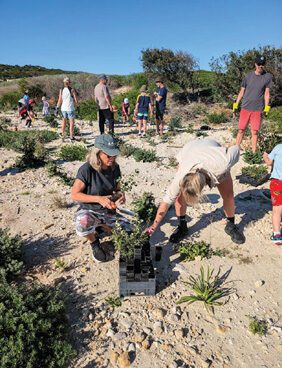
Regeneration efforts in Curl Curl

Ms Furniss highlighted that the last 18 months have seen an increase in ‘additional associated reckless behaviour, including vandalism to dune flora and lighting fires.’
Ms Furniss said coastal dunes were ‘extremely important’ to the environment, acting as a defence from erosion, absorbing storm and wave energy, and providing habitat for native flora and fauna.
Justin O’Hare, who runs Curl Curl Community group, echoed the importance of dunes and said that they are ‘a really fragile environment’ where it is already difficult for vegetation to survive.
Having led bush regeneration efforts in Curl Curl for around a decade, Mr O’Hare said that a lot of damage could be avoided if the community had better education around the consequences of being on the dunes.
“People think, ‘I can’t do any damage, it’s just the beach,’” Mr O’Hare said.
“But the most critical part of a sand dune is the top and the front, ocean-facing part. People shouldn’t even be walking on it, let alone having bonfires on it.”
Mr O’Hare said that it was not about telling people to stop gathering on the beach altogether, but rather to ensure they are completely off the dunes, which are usually fenced off or marked by signage.
“There needs to be education about how fragile the environment is and that it could all just disappear,” he said.
Ms Furniss agreed that education should be a significant part of an awareness campaign, including engagement with schools, but also highlighted the need for stronger enforcement.
“At the moment, there is no deterrent, there is no enforcement and there is no education. All of those things need to happen,” she said.
“The message is really clear, and the evidence is clear that action needs to now be forthcoming.”


