


Fast to build, more sustainable homes are becoming the mantra of councils and governments keen to find a greener solution to the housing crisis – at a cost Australians can afford. Simran Gill reports.
The way Australians build homes is changing. Driven by a worsening housing crisis, rising energy costs and growing awareness of the construction industry’s environmental footprint, a quiet revolution is underway and Western Sydney is at the heart of it. For decades, the standard Australian home has been built the same way: timber frames, brick veneer, poured concrete slabs. It is a formula that works but one that is slow, wasteful and increasingly out of step with what the planet, and the hip pocket, can sustain. Now, a new generation of materials, methods and thinking is beginning to reshape what it means to build a home, and the shift is accelerating faster than many people realise.
“Green building in Australia has moved well beyond niche,” says Elham Monavari, head of Green Star strategic delivery at the Green Building Council of Australia.
“What was once considered optional is increasingly expected by buyers, renters and governments. Rising energy costs, extreme weather and stronger building standards are accelerating this shift, especially in areas like Western Sydney where temperatures often climb above the national average.”
The most immediate thing any homeowner can do, Ms Monavari says, is get the fundamentals right. For new builds, that starts with orientation. Designing a home to capture winter sun and reduce summer heat can dramatically cut heating and cooling needs without spending a dollar on technology. For existing homes, upgrades like better insulation, double-glazed windows, ceiling fans and external shading deliver immediate comfort and savings. Add rooftop solar and efficient electric appliances, and the results are significant.
“Our modelling shows energy-efficient, all-electric homes can save households up to $1,700 a year on energy bills compared with a typical home,” Ms Monavari says.
“Over the life of a home, those choices add up to tens of thousands of dollars in savings.”
Beyond the basics, the materials going into new homes are also evolving. Think about the old bike rusting in your garage or the barbecue you retired last summer. According to Sean Mannering, executive general manager of distribution and processing at InfraBuild, that steel has a continuous life ahead of it.
At InfraBuild’s Electric Arc Furnaces in Rooty Hill, scrap steel collected from across the community is melted down and reshaped into brand new products ready to go back into Australian homes.
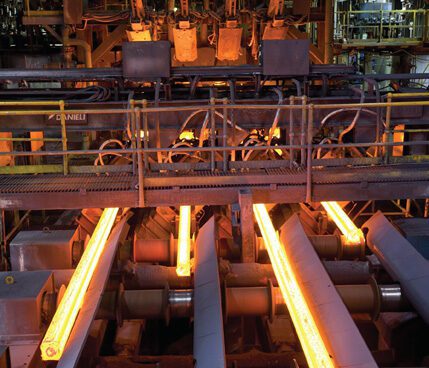
Steel billets produced at Infrabuild
“It’s a genuinely circular system of collecting, recycling, remelting and remaking,” Mr Mannering says.
Electric Arc Furnaces produce around 75 per cent lower carbon emissions than conventional coal-fired blast furnaces, and InfraBuild’s SENSE 600 reinforcing steel generates up to 49 per cent less embodied carbon than the industry average. While there are several InfraBuild branches in Western Sydney, there are locations in Botany, south Sydney and regional areas.
Sustainable choices extend beyond the steel frame. InfraBuild also produces LOKPOD, made from 100 per cent recycled Australian plastic, as a smarter alternative to traditional polystyrene pods in concrete slabs, reducing the amount of concrete needed while diverting plastic waste from landfill.
“Greener choices don’t have to be complicated or expensive,” Mr Mannering says.
“We’re working hard to make sure they’re just the normal way to build.” Reduced carbon concrete, produced by companies including Boral and Holcim at facilities in Lidcombe and Hurstville, is also becoming more common in residential construction.
At the more ambitious end of the spectrum, 3D construction printing is beginning to make its mark on Australian soil. Contour3D, based at Kurnell in Sydney’s south, is among the pioneers bringing this technology to life locally, featuring on Jamie Durie’s Future House on Channel 9 last year. The process promises faster build times, reduced material waste and new possibilities for sustainable construction.
Nowhere is the momentum more visible than in the NSW Government’s embrace of modular and prefabricated housing. In September last year, the NSW Government invited the public to tour one of the state’s first modular showcase sites, part of its record $6.6 billion Building Homes for NSW program. The government is delivering 90 modular homes across the state this financial year, with suburbs including Guildford and Whalan among those receiving prefabricated homes expected to be built in 16 to 20 weeks at around $500,000 each.
“These aren’t ‘shitboxes,’” Housing Minister Rose Jackson said at the launch.
“They are beautiful, modern homes built to last. This is our secret weapon to tackle the housing crisis, building faster, reducing waste and delivering the quality homes our state needs.” Mathew Aitchison, CEO of Building 4.0 CRC, adds that systematising construction ‘can reduce waste, cut delivery times and give families access to homes that are modern, adaptable and built to last.’
Elham Monavari from the Green Building Council believes the government push will ripple beyond social housing.
“As designs improve and confidence grows, I expect these methods to become far more common for private homes. They offer a real opportunity to lift sustainability and quality at scale and provide more predictable cost and timeframes, which is appealing for retirees planning a downsized move.”
A compelling local example is Ed.Square in Edmondson Park, which has achieved a 6 Star Green Star Communities rating, integrating all-electric homes, large-scale rooftop solar and strong water efficiency measures alongside walkability and green space.
“It shows what is possible when sustainability, affordability and liveability are designed together from the start,” Ms Monavari says, “particularly at the scale Western Sydney is growing.”
Local councils are also playing their part. Fairfield City Council is working with Homes NSW to incorporate provisions for modular and prefabricated dwellings within its development control plan, with a council spokesperson acknowledging that while developers often prioritise upfront cost efficiency, there is growing interest in more sustainable outcomes.
Camden Council actively promotes its Built for Comfort initiative, connecting homebuilders with an independent expert for free advice during the design stage and has engaged ZapCat, a certified social enterprise, to support residents to improve energy efficiency and electrification in both existing and new homes.
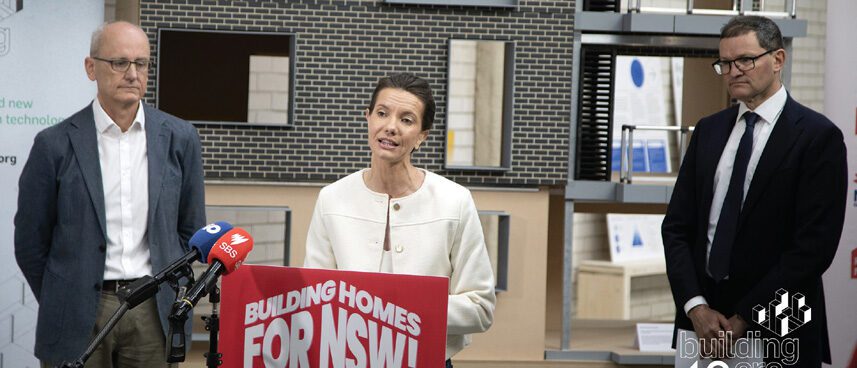
Housing Minister Rose Jackson at the Modern Methods of Construction showcase in September, 2025
For anyone who is thinking about the sustainable or modular route, looking at the financing picture is worth understanding early.
Rafka Veas, finance broker at Western Sydney Finance, says modular homes can be financed, but not always on the same terms as a traditional build.
“Some lenders will only lend against land value with loan-to-value ratio restrictions, which creates a larger funding gap as clients will be required to provide a larger deposit until the property is fixed onto the site.”
Policies vary significantly between lenders, and some impose restrictions on which licensed builders they will accept, limiting a borrower’s choice of modular or prefab builder.
“It would be highly recommended that the client engage with an experienced mortgage broker or their preferred financier to understand the specific requirements and risks associated with the lending process,” Ms Veas says.
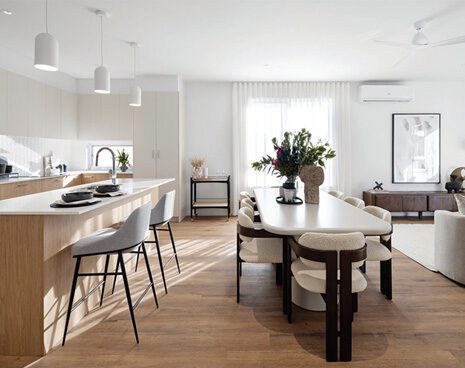
A unit in a ‘green’ building in Heathcote
The lending landscape is beginning to shift though.
CommBank became the first major bank to offer construction finance during the offsite building phase for prefab homes in early 2025.
Green loan products offering discounted rates for energy-efficient builds also exist, though Ms Veas notes the market remains patchy.
“Each lender has its own definition of what qualifies as green, which may include minimum NatHERS ratings, energy efficiency benchmarks or recognised certifications.”
For those building in Western Sydney specifically, Ms Veas sees demand only growing.
“Ongoing development, house and land packages and knockdown-rebuild activity are increasing demand for homes with energy efficient features to help reduce long term living expenses.”
Her advice for first-time builders considering the sustainable or modular path is straightforward: do your homework before you sign anything.
“It is important to understand not all lenders treat modular construction the same as traditional builds, particularly in relation to progress payments, builder requirements and valuation considerations.”
The researchers behind some of Australia’s most forward-thinking housing work argue that what is needed now is better systems for turning good ideas into mainstream practice. Academics at Western Sydney University’s Urban Transformations Research Centre, including Ehsan Noroozinejad and Greg Morrison, have been making the case for Living Labs: real-world platforms where government, industry, universities and communities can test and refine new housing approaches together before scaling them.
It is a reminder that the building revolution underway is not just about materials and methods. It is about building the confidence, the infrastructure and the shared will to do things differently.
As Ms Monavari puts it, the goal now is to make high-performance sustainable homes the default rather than the exception. In Western Sydney, that future is already being built.