


Hostility towards teens has exploded on the Beaches – home to one of NSW’s fastest growing ageing populations. But with youth crime declining, is it media scaremongering or warranted?
Griping about youth is nothing new. Social media screams about teens chasing chaos, but with stats showing a decline in youth crime, do teens merit the angst, or are the actions of a few tarring Gen Alpha?
It’s 3pm at Kamilaroi Park in Bayview. The swings are having a post-school work-out. “Too loud, go home, this is a quiet area,” shrieks a neighbour, frequently calling the police or council to report kids playing in their own park, PL is reliably informed.
The suburb is one of the oldest 10% of areas nationwide, with Northern Beaches Council’s (NBC) Local Housing Strategy showing a 21.5% jump in older households since 2016 and young households just 0.7%. Australian Bureau of Statistics (ABS) reports a crime rate of 0.0165 per 100,000 people. Public spaces are policed by perception and the very hallmarks of youth – groups, chatter, late nights – chafe against this controlled suburb. “We’re always too old or too young for anything,” Charlie, 14, who lives in Bayview, tells PL, saying she feels ‘caught’ between childhood and adulthood yet belonging to neither. “To shopkeepers we’re suspicious, to neighbours we’re noisy, in town we’re loitering.”
Sure, there are playgrounds and pubs crawls a-plenty, but where do the teens go? Off the sport court or sand, there are few safe, affordable social venues and, with transport lacking, teens are visible in the ‘wrong’ places. “Some kids are doing the wrong thing, but most of us are just doing school, sport and seeing friends, same as always,” adds Charlie.
The Beaches sits in the lowest crime bracket in the state, so antisocial behaviour garners intense attention. Social media amplifies and repeats until we are certain that crime is exploding as never before. On the Beaches, youth crime fell by 15% over the 10 years to December 2025, says a new report from NSW Bureau of Crime Statistics and Research, (BOSCAR). There were 534 crimes per 100,000 people of all ages last year, compared to 5,275 in the highest-ranked Walgett. Nationwide, young offenders have fallen by 28% in a decade, says the ABS.
Our teens are coming of age in an era where hard work no longer equals security. Housing affordability has collapsed, climate change looms and social media zaps mental health. The ratio of house prices to earnings has quadrupled over the past fifty years in Sydney, says PropTrack, and a record rental crisis and NBC shortfall of 8,100 affordable homes hasn’t helped.
Holding onto high schoolers is our economic golden ticket, yet NSW school retention languishes at its lowest point in a decade, with every LGA recording lower attendance rates in 2023 than 2019, says BOSCAR. Also on the wane is mental health support, with just one counsellor per 500 public schoolers, despite Lifeline Northern Beaches finding that 34% of those aged 14 to 19 have experienced suicidal thoughts in the past year.

Dr Sarah Tashjian, Head of Lab at the Affective Neuroscience and Development Lab, University of Melbourne.
Eager to turn the tide is Sydney-based Lifeline ambassador Matthew Caruana, 26, who became paraplegic at 16 after attempting suicide. He now works as a mental resilience advocate, also competing on the Australian National Para Climbing team. “One of the most common things young people tell me is that they don’t feel understood by adults and that disconnect can have a real impact on their mental health,” Matthew tells PL. “Many teenagers feel they are being judged by the actions of a small minority. Whether it’s a lack of trust, unrealistic expectations or assumptions about their generation, the message many young people receive is that they are not fully understood or valued.
“Teenagers are looking for connection, trust and recognition. They want adults who are willing to listen, understand their perspective and acknowledge their strengths and achievements. “Communities play a critical role in this. Whether through sport, volunteering, creative pursuits, leadership opportunities or community initiatives, these experiences allow young people to build meaningful relationships and put their strengths to positive use,” adds Matthew.

Mathew Caruana works as a mental resilience advocate
“Many teenagers feel they are being judged by the actions of a small minority.”
Matthew Caruana, youth mental health advocate and speaker.
Keen to shape the future is Northern Beaches Council’s Youth Advisory Group (YAG) which represents the voices of young people in local government, including the Youth Voice Action Plan 2023-2028. Keep A Look Out For (KALOF) connects young people to events and opportunities, while Better Together 2040 works to ensure that the area is socially sustainable, such as access to work and volunteering opportunities.
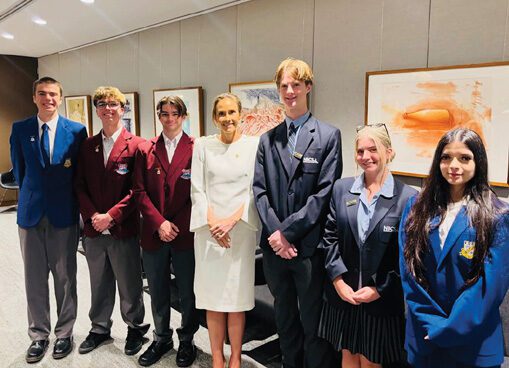
MP Jacqui Scruby at the Secondary School Leadership Program
Taldumande Youth Service has a Beach Reach initiative, a night mobile outreach service launched with NSW Police. The service, which operates across the breadth of the Beaches on a Saturday evening, ‘positively engages’ with young people to get them home safely and frees up police resources. MoWaNa Safe Space supports youth across Mona Vale, Warriewood and Narrabeen, while Beaches Youth Hub Avalon offers free confidential counselling.
But why should the community get behind kids that don’t warrant it? The ones allegedly kicking B-Line buses, threatening shopkeepers and dodging bus fares, as reported on several Beaches social media streams. On the Beaches, the e-bike is a theoretical green dream-turned rogue of the road with few regulations and rash decisions. Warriewood’s Mater Maria is rolling out steps including online education programs ‘to ensure all students are equipped to ride responsibly and safely,’ says an email sent home to parents, while others urge a blanket ban for under 16s.
But MP for Pittwater, Jacqui Scruby, says that the focus should not solely be on age limits. She has launched an E-Bike Safety Bill to call for a licensing and registration scheme and a 10km/hr speed limit on footpaths for all bikes.

NBC is calling on young people to get involved with its Youth Advisory Group
“While there are lots of benefits, some regulatory reform is urgent,” she tells PL. “Not all kids are doing the wrong thing at all. Most are lovely and just hanging out like we all would have (in our youth). Yes – their bikes should meet legal requirements but even if they don’t, the key issue (I have been told about) is throwing things at cars, stealing from Woolies and that is only a few kids, I’m sure. I’m not demonising teens – I have them myself!” she adds.
University of Southern Queensland communications professor Andrew Hickey tells the ABC that young people have been turned into the proverbial ‘folk devil,’ who take the blame for society’s ills. “What we’re seeing with the current ‘crime crisis’ is this has become real in the public imagination, even if statistics tell us rates are declining,” he says.
On a physical level, the last brain structures to mature are the prefrontal cortical structures which manage thinking, with young people often making impulsive decisions. “Adolescence is a time of enormous transformation – emotional, social and physical,” says Sarah Tashjian of the Affective Neuroscience and Development Lab, University of Melbourne. Teens will never make decisions as an adult would, but washing our hands of them is short-changing the community we are seeking to save.