


Fuel shortages have sent electric vehicle sales soaring, but will a lack of infrastructure to accommodate charging slam the brakes on the boom? Catherine Lewis reports.
Battery electric vehicles have doubled their market share following the start of the Iran war, says the Federal Chamber of Automotive Industries, (FCAI) as Australian drivers scramble to futureproof against petrol costs soaring south of $2.40/litre (at time of print). Up to 60% cheaper to power, open to tax exemptions and less polluting, going electric seems win-win. Yet in this country, there are 45 EVs fighting for each public charging point, compared with a global average of 11, says the International Energy Agency. So, is this electric dream truly viable or will it be stalled by a charging crisis?
There are four different types of EV – a plug-in all-electric vehicle (BEV) with a rechargeable battery, a plug-in hybrid electric vehicle running on battery or fossil fuels, a hybrid-electric combustion vehicle, and a fuel cell electric vehicle that uses hydrogen gas fuel cells. Amid a Strait of Hormuz fuel squeeze in March, sales of these EVs rocketed to 14.6% – 15,839 – of Australia’s total vehicle sales, doubling February’s tally and that of March 2025, while petrol-powered vehicles slumped 20.8% year-on-year.
CommBank saw a 161% lift in weekly loan volumes for new BEVs, with business loan applications for Tesla vehicles alone up 268% in March compared with a year ago. Even the used-EV market is growing, with Pickles auction house reporting a 60% uptick in used EVs.
Toyota Australia, which has showrooms in Mona Vale and Brookvale, tells PL that it has increased its annual sales forecast for 2026 to meet demand for EVs and has recently rolled out seven new models, taking its electrified range to 19. “In the first three months of the year, Toyota has seen an increase in demand for electrified vehicles – including battery-electric vehicles and hybrid vehicles,” says John Pappas, Toyota Australia vice president sales, marketing and franchise operations.
“Today, hybrid vehicles are affordable, accessible and convenient for customers across the range,” he says. Mr Pappas adds that Toyota is also seeing ‘massive growth’ in interest in its bZ4X mid-sized battery electric SUV, which saw its highest ever monthly tally in April.
Global events are turbo-charging a market that was already moving into the fast lane. Late last year, NSW celebrated a milestone 100,000 EVs, saving an annual 121 million litres of petrol – nearly 145,000 tonnes of CO2 emissions. There are now more than 110 EV models and over 50 plug-in hybrids available within the Australian market, says the FCAI, in line with NSW Government’s $209 million EV Public Charging Master Plan’s goal to ensure EVs represent half of new car sales by 2030.
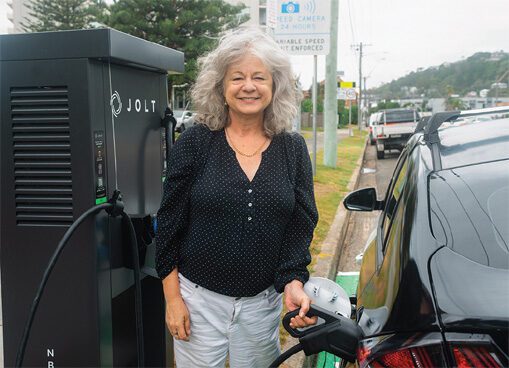
Northern Beaches Council Mayor Sue Heins says that the Beaches has one of the highest uptakes of EVs
The Electric Vehicle Council says a single national charging plan is needed to meet the demand and is frustrated at the slow rollout of kerbside chargers. High fees – Government figures estimate a fast-charging station to cost over $1 million – and connection times of up to 18 months by distribution network service providers, which own the grid’s wires and poles, are hindering growth. Unwilling to wait is the ‘New Energy’ Chinese car giant BYD, which has seen enquiries for its EVs spike by 50% since the fuel crisis. BYD has announced plans to build its own ultra-fast charging network across Sydney, Adelaide and Melbourne from October this year.
FCAI chief executive Tony Weber tells PL that a long-term shift to EVs will require Australian governments to ‘sharpen their focus’ on public charging infrastructure. “Demand must be matched by a step change in both public and private investment to ensure infrastructure keeps pace. Access to convenient charging continues to influence purchasing decisions and for many apartment residents and renters, particularly those without off-street parking, reliable and convenient charging is still not guaranteed. These are real, everyday constraints that shape how quickly the market can transition,” he says.

Tony Weber, FCAI chief executive, says Australian governments must sharpen their focus on public charging infrastructure
Enter the $100 million 2026 NSW Electric Vehicle Strategy, which will focus on expanding the fast-charging network across blackspots and increasing kerbside chargers for those who cannot charge at home, such as apartment dwellers. To date, the NSW Government has funded more than 3,300 EV chargers across more than 1,200 sites and it aims to expand the EV Fleets Incentive Program to allow organisations to electrify their fleets alongside upskilling an EV workforce, including specialised mechanics.
Councils can apply for part of a $3 million funding pot to build capability and plan for further public charging rollout, says Minister for Climate Change and Energy Penny Sharpe, adding that the strategy will help to build a ‘world-class’ charging network. “Owning an electric vehicle helps households and businesses save thousands of dollars on fuel and around 40% on maintenance. This strategy will get more EVs on the road and help drivers travel and charge with confidence,” says Ms Sharpe.
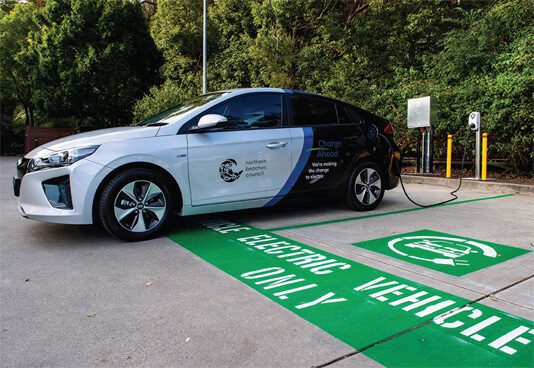
Council is encouraging residents to switch to electric vehicles
Partnerships between Government and private operators are underway as part of a $500 million Driving the Nation fund, with NRMA rolling out more than 100 fast-charging sites to connect national highways, creating a ‘backbone’ charging network. BP and Ampol are installing ‘thousands of additional high speed-plugs’ this year, says the Department of Climate Change.
On the Beaches – one of the fastest growing areas for EVs – Mayor Sue Heins tells PL that Northern Beaches Council is working towards a target of a 30% reduction in vehicle emissions by 2038. This is via its MOVE Transport Strategy and Electric Vehicle Charging Infrastructure Plan. Council also confirmed that it has this year resolved to support the progression of an open market Expression of Interest for EV chargers on council land and is in the final stages of releasing the EOI to the market.
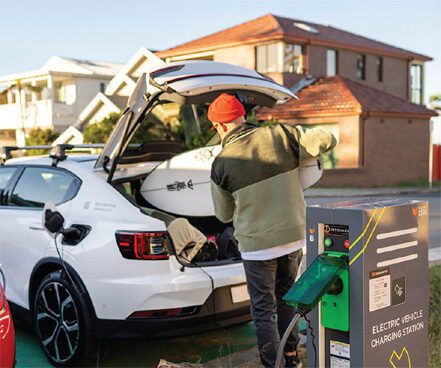
Based on the CSIRO’s anticipated demand for EV Vehicles, there is a future need for a total of 973 Level 2 chargers, 112 Level 3 charges, and 14 Level 3 fast chargers across the Beaches. Currently, there are 26 on-street public electric vehicle charging locations and several charging stations in commercial areas. “Electric vehicles are rapidly becoming part of the future of transport,” Mayor Heins says.
“Council is committed to help deliver the charging infrastructure required to support the transition. By working with industry and opening up the capacity to use council land, we aim to deliver better outcomes for our community while reducing transport emissions.”
But is the switch to electric here to stay? FCAI’s Tony Weber says it’s ‘too early’ to tell, but what is clear is that charging confidence is in a cul-de-sac. Removing roadblocks to EV explosion via a sustainable charging structure and real-time charging network app updates allowing drivers to plan, will be the key.