


This month’s Youth Week and Earth Day both call for collaborative thinking and bold action to protect our planet. Catherine Lewis meets the youth environmentalists in our community who are leading the charge.
Stepping up and speaking out can be a daunting prospect, but for Sophia Skarparis – aka Plastic Free Sophia – it was all part of an enduring drive for change.
One in three young Australians report feeling ‘eco-stress,’ meaning that climate change is negatively impacting their daily lives, says a report by Mission Australia and Orygen. Sophia, who lives in Willoughby and attended Monte Sant’ Angelo Mercy College, was keen to do something about it, despite being just 14 years old at the time.
“We want change, but most young people just don’t know where to start,” she tells NL. “I had to complete a school project in Year 10 and around that time, I had started noticing plastic litter scattered across the soccer fields where I trained.
“Plastic bags contaminate ecosystems, harm marine life and never fully decompose. I launched a petition to ban lightweight plastic bags in NSW. I went to schools, movie theatres and local farmers’ markets, and mobilised over 12,000 signatures for my petition.”
Sophia presented the petition to the NSW Premier and it was tabled in Parliament in October 2018, sowing the seed for the implementation of the NSW Plastics Action Plan in 2021. “By 2023, all states and territories had banned lightweight plastic bags,” she says.
Sophia – a 2024 Australian Representative of World Ocean Day, Youth Advisory Council 2024 and 2018 North Sydney Young Person of the Year – tells NL that she is most proud of her work organising and supporting youth mobilisation during World Ocean Day, showing young people that they ‘don’t have to wait’ for permission to lead and make positive change. “I’ve spoken to over 60,000 students across Australia about sustainability and youth participation, helping young people realise they are powerful,” she adds.
Sophia is one of many local young people stepping up to put the theory of this month’s Earth Day and Youth Week – both of which call for urgent action to improve our communities and safeguard our environment – into practice. Now marked by more than one billion people across 192 countries, Earth Day – held each year on 22 April – kicked off in 1970 to combat eco threats including climate change, plastic pollution and deforestation. It all started with biologist Rachel Carson’s book, Silent Spring. In the smog of the 1960s, as fossil fuels exploded to power a booming car industry and pesticides clouded rich farmland, pollution was positive, prosperous, a sign of thriving industry. Carson flipped the script, warning of impacts on health and environment and US President John F. Kennedy agreed.
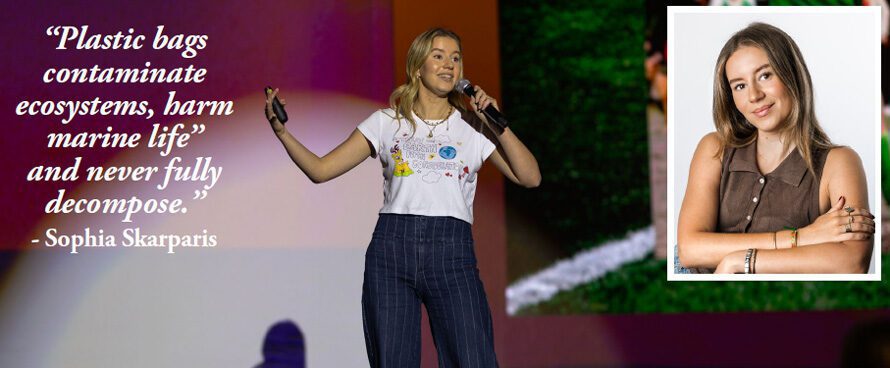
Sophia Skarparis speaking at the Youth Ocean Carnival
This year’s theme, Our Power, our Planet, calls for collaborative action in line with Youth Week (16 to 26 April) a national initiative encouraging people aged between 12 and 24 to share ideas, showcase talents, attend live events such as Open Mic nights and advocate for positive change within their local area. Hafsa, 15, a member of the 2026 NSW Youth Advisory Council and creator of this year’s ‘Dream. Dare. Do’ theme, says that the premise ‘encourages creativity and courage, inspiring young people to dream big and take real steps to make those dreams happen.’
Sophia now plays a key role in Stay Tuned to our Planet’s (STTOP) new sustainability program, which urges youth to take small actions in their own lives, whether that be organising a clothing swap or cutting down on plastic at school. The program contains free YouTube lessons aimed at those in Years 5 to 9, examining environmental issues and highlighting simple, achievable ways to be part of the climate solution. Sophia also uses her own social media to call other young people to action, sharing volunteering opportunities, eco events and petitions for planet protection. “I aim to keep building community spaces (online and in-person) that make sustainability feel empowering, as well as speaking at more schools, conferences and global climate spaces to elevate youth voices,” Sophia tells NL. “The future is unwritten. And youth have the power to rewrite it for the better.”
The collective power of Earth Day has led to landmark legislation across the globe – from the US Environmental Protection Agency to the Clean Air, Clean Water, Endangered Species and Marine Mammal Protection Acts. It also serves as a platform for local, community-driven action. In Australia, it inspired the Nature Repair Market Scheme, a voluntary national biodiversity market scheme which encourages people and businesses to invest in projects that restore and protect the natural environment.
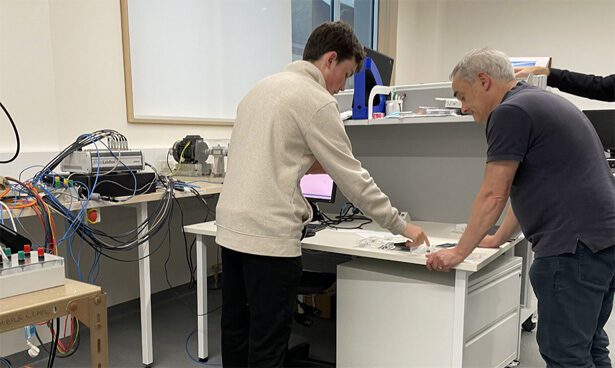
Ben Lenehan (left) founded Watergate Labs, which makes renewable energy generators that produce electricity
This includes planting trees on farmland, re-establishing vegetation along waterways and encouraging the use of Indigenous knowledge – key tools to address the crisis, says Biodiversity Council director James Trezise, warning that Australian nature is ‘experiencing a precipitous decline.’ Earth Day has also fostered a culture of volunteerism, of stepping out to help others, with organisations such as Conservation Volunteers Australia, springing up.
UNSW student Ben Lenehan started his business, Watergate Labs – which makes renewable energy generators that produce electricity chemically, using mains water – while still in Year 10 at school. “I have always been a person who is actively looking for ways to challenge and solve issues, and a big one is Climate Change and the things we do as humans to damage the environment. I would describe myself as a climate-focused engineer,” he tells NL. There is now a waiting list of homes across the Lower North Shore and the Northern Beaches keen to have one of the generators installed.
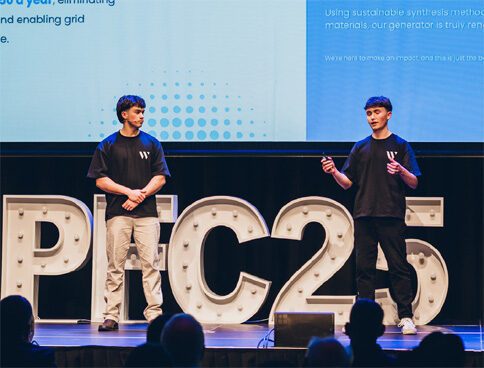
Climate-focused engineer Ben Lenehan speaking at the UNSW Founders program event
“Because our generators can use water directly from your garden hose, they work 24/7 and under all weather conditions, making it the world’s first 24/7 continuous renewable energy generator,” adds Ben, who is part of the UNSW Founders program. A Watergate generator can power a large home independently for an entire year for under $150, eliminating energy bills and enabling grid independence – remarkable for a technology that was initially self-funded by Ben’s after school work in a chicken shop and developed in a corner of his mum’s kitchen. This year, Ben aims to scale Watergate until it becomes a household name and renewable energy is being generated in every home worldwide.
“What inspired me was the opportunity to make a technology like mine work and the positive impact it could have on the world. There are just so many applications that our technology could be integrated into to ultimately turn the world over to using 24/7 renewable energy. I encourage other young business minds to pursue a venture in a space that they’re passionate about as passion is motivation.”