


Paralympic snowboarder Ben Tudhope is back on the Beaches after a stunning Winter Games. Given his parents were told after birth he may never walk, Tamara Spray uncovers the secret of his success.
Manly’s medal-winning snowboarder Ben Tudhope went into the Milano Cortina 2026 Paralympic Winter Games with a simple mantra in mind. “I took it one step at a time, one day at a time, and I really enjoyed the courses that they gave us,” Ben says. “I was just having fun. And I know that’s the deadliest thing about me – if I am having fun, if I have a smile on my face, then I know I’m hard to beat.”
It’s a strategy that comes from experience. Aged just 26, this was Ben’s fourth Winter Paralympic Games. This time around he was the sole Australian medal winner, claiming silver in the big final of his race category SB-LL2 snowboard cross on Day 2, and bronze in the SB-LL2 banked slalom on Day 7.
Since returning from Italy in March, Ben’s whirlwind schedule has been a flurry of meetings and media interviews. He met Prime Minister Anthony Albanese at Parliament House in Canberra, and even had a chance meeting with current UFC featherweight champion Alexander ‘Volk’ Volkanovski.
“It was weird because about two minutes before the Prime Minister walks in, Volk comes in to meet the Prime Minister too. So I’m meeting the Volk, the PM and the Minister for Sport Anika Wells,” Ben says. “It was different worlds colliding!”
Ben and Grant Mizens, Paralympics Australia president, were also hosted by Warringah MP Zali Steggall, a Winter Olympian herself, at the MP’s office in Manly. “I’ve known Zali for a while,” Ben says. “She’s been a big supporter of me and my career, so it was great to catch up – it felt like old friends.”
Not far from Zali’s office, on the East and West Esplanade, Ben is one of 100 Northern Beaches sports people recognised with a plaque on the Manly Pathway of Olympians. “That was put there after my first games in 2014, so I’ve had it for a while but it’s always pretty surreal seeing it there,” he says.
At those first games, Ben was 14, becoming the youngest competitor from any country at the Winter Games in Sochi after receiving a wild card entry from the International Paralympic Committee.
He then competed at Pyeongchang in 2018, and was the only Australian to medal at Beijing in 2022, claiming a bronze in the snowboard cross SB-LL2 event.
Over the years, Ben, who was born with left hemiplegic cerebral palsy, has seen a shift in the way the Paralympic Winter Games are received and viewed by the public. “I’m all about showing off the sport and that’s basically what I want to do – show how cool Paralympic snowboarding is.
“A lot of the messages I’ve got in the past have been ‘congratulations on your medal,’ or ‘congratulations on being at the games.’ But there has been this changeover between the Beijing Games and Milano Cortina. The messages I’m now getting are about my performance, like ‘you snowboarded awesome.’ That tells me that people are watching the Games and watching my performance, not just seeing a little post on social media or in the newspaper.
“It’s a small thing, but it just shows how far the Paralympics and winter sport has come, especially now people can watch my performance live and on-demand on television.”
Ben was 12 months old when he was diagnosed with celebral palsy (CP). His parents, Andrew and Melissa, realised Ben wasn’t reaching his milestones at the same rate as his older sisters, Annabel and Phoebe. “My parents were told I may never be able to walk or talk, so they got given the worst news,” Ben says.
He started therapy at the Cererbal Palsy Alliance in Allambie Heights, and says his parents were given lots of ‘maybes’ as he was growing up. He describes Cerebral Palsy as an umbrella term, covering a range of issues people can have, like difficulty swallowing or epilepsy.
“I guess every step of the way there would just be more questions marks. But throughout my development and the kind of therapy I had, it became ‘Ben is able to do this, Ben is able to do that.’
“I’m grateful to have parents as amazing as mine because they were the ones pushing for me to do things (like school sport), even though they had questions in the back of their heads. They just wanted to treat me equal to my sisters and my friends.”
So it was a given that Ben would join in the family passions of skiing and snowboarding. He spent every winter weekend at the ski fields in Jindabyne NSW, and school holidays at Mount Hotham, Victoria.
He was skiing at age three, and tried snowboarding at eight. Ben was keen to keep up with his sisters, and despite his CP affecting the left side of his body ‘from head to toe,’ leaving him with less coordination and control on that side, he had patience to repeat and perfect the moves.
It’s made him the elite snowboarder he is today. “I have to really focus on that left side and position,” Ben says, adding that both of his arms, legs and even little finger all need to be in the right position to master certain moves. “There’s a lot more focus on the timing and repetition of a particular movement until it becomes natural. Having CP growing up, I’m a patient person.
“No one will be able to see it with the naked eye, but for me, in my head, that’s what I’m focusing on.”

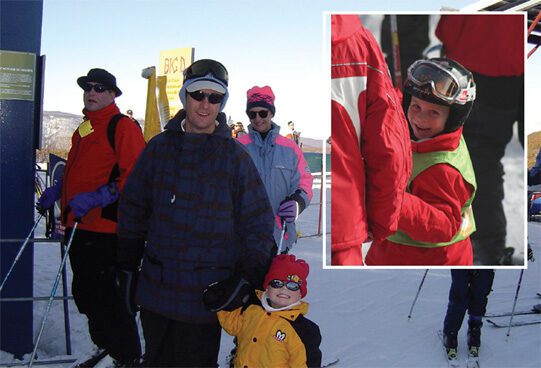
Ben, with dad Andrew, started skiing as a three-year-old
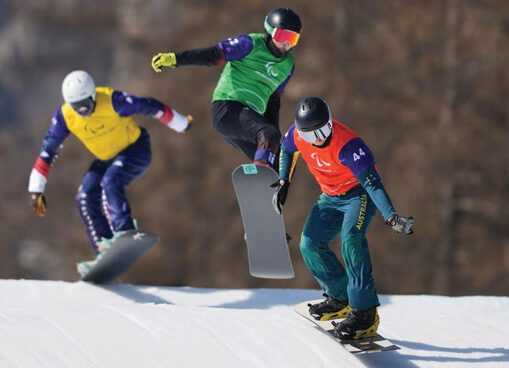
Ben (far right) claimed a silver medal in the Para snowboard cross
“Every hour, every minute, every second of the day, for the last four years, have been leading to this moment.”
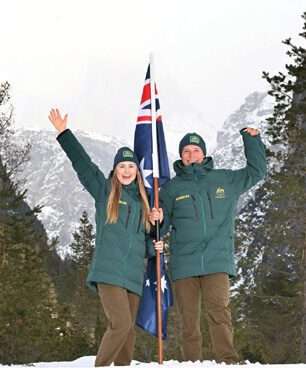
Paralympic Winter Games 2026 flag bearers Georgia Gunew and Ben
A former student at Shore in North Sydney, Ben competed in interschool sports competitions, and was snowboarding (and beating) able-bodied competitors, blissfully unaware of the Paralympics. He was snowboarding at Jindabyne, travelling overseas for snow camps, when it was announced that snowboarding was to debut at the 2014 Winter Paralympics.
It was 2011, and in Jindabyne, high performance coach Peter Higgins was looking for anyone with a disability to try snowboarding. Ben says he was 10 when his coach at the time, Peter Baff, nominated him. “He said, ‘Hey, we’ve got this young kid, he’s a ripper of a snowboarder, do you want to meet him?’” Ben recalls.
Within three years of commencing training with Peter Higgins, Ben was competing aged 14 at his first Paralympics. “The Paralympics are so good for sport, it’s a platform for athletes to be able to motivate the next generation of people living with a disability… to come out of their shell and not let the disability control them.
“Just so they can know that they can do whatever they want in their life. It doesn’t have to be in sport,” he says.
“I think there’s so much put into a box about disability and people living with disability becoming Paralympians, but only a fair few get to compete at that high level. So for those of us lucky enough to be able to perform at that (elite) level, it’s just to motivate people to do what they want.”
Coming into the 2026 Games, Ben, who is the first Australian winter athlete to win 50 World Cup medals, says he had a ‘fresh outlook.’ “I wasn’t excited, I wasn’t nervous, I just stayed level-headed. I didn’t have the best season this year. I can happily say that for most competitions in the lead up (to the previous Games) I’ve been on the podium more than I’ve been off the podium.
“This year we had 10 competitions, and I’d been on the podium three times. So I wasn’t sure going into these Games if I was going to get a medal.
“I just kept saying to myself that the next competition was the most important, so there was no timeline, no countdown to the Games.”
Ben describes his time on the Paralympic podium as ‘emotional.’ “I saw my mum. We made eye contact and I definitely had a little tear,” he recalls.
The snowboarder says he found his second event, the SB-LL2 banked slalom, a greater challenge. “It was hard to go from such a high (winning a silver). The pressure was off. So for this one, I had to keep reminding myself, ‘I can medal here, I can perform here.’”
And he did, winning bronze and clocking his best time of 57.33. “It was unexpected to get that second medal, a surprising feeling. But I was relieved that I got that one. It was incredible.”
The raising profile of Para sport has corresponded with a shift in sponsorship and funding, but Ben says a gap still remains. “The biggest difference for me, compared to an able-bodied athlete, is we don’t get prize money for any of our competitions.
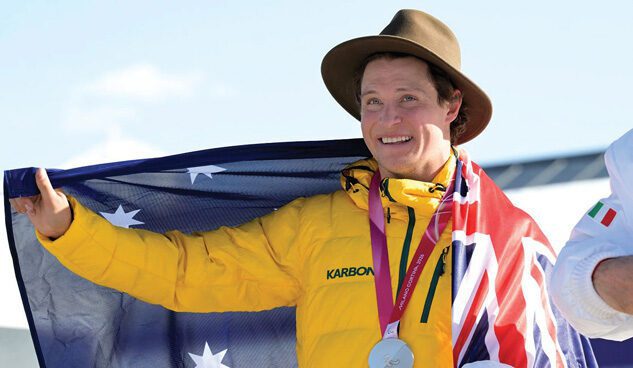
“It’s always a struggle to get funding as an athlete,” Ben says. “I’ve been fortunate now that leading up to the last two Games I’ve been sponsored by some big companies. I’m so thankful for them putting my name out there in the media, but also putting the Paralympics and Para athletes out there in the media. Because when I started, there was (no media coverage). And there were no corporate sponsorships for Para athletes.”
Ben adds that while he is now in a good financial position, he is still supported by his family, and works as a marketing coordinator for Burton Snowboards in Brookvale.
So, what’s next for Ben? “Every hour, every minute, every second of the day, for the last four years, have been leading to this fun moment,” the medal-winner says. “I definitely see myself going to the 2030 (Winter Paralympics), but I just need some time to reset, refocus and refresh the mind.
“Working is the main thing,” Ben says. “Just doing all my hobbies, my regular activities, being a normal 26-year-old – not taking myself too seriously, but using my platform to motivate the next generation too.”

Ben celebrates his silver medal with parents and friends