


The life of Mercury Psillakis was cruelly taken away by a shark almost 12 months ago. Wife Maria has turned her grief into action so that ocean users have better protection. Editor in Chief Michelle Giglio reports.
A pair of glasses sit undisturbed on a desk in the Psillakis house. They have sat quietly, unused, since that fateful morning on Saturday, 6 September, when Mercury Psillakis left his home for the last time.
Beloved father, husband, brother, son, friend and Dee Why surfer, Mercury was killed that day by a Great White shark, doing something that he loved.
Wife Maria Psillakis has been steadily working away on a campaign to make our beaches safer so no one has to suffer the pain that she and daughter Freedom have felt every single day since Mercury – known lovingly by all as ‘Merc’ – died.
“I just don’t want another family to through this thing that shatters you,” Maria says softly. “It takes a breath out of you and shatters you and leaves you numb.
“I don’t know what I feel anymore. Because he’s everywhere. I just feel him everywhere,” she says looking searchingly around their home.
Maria admits she ‘talks’ to Merc a lot. “Which I know sounds nuts!” she laughs. “I’ll be sitting in the office and I’ll be looking at his empty chair. The quietness in the house is sometimes quite unbearable. But I look at his empty chair and his glasses are still where he left them. And I just don’t have the heart to move them.”
Merc’s death shocked a nation where Australians know the danger from sharks, but up until now we have largely managed to use oceans in harmony with these apex predators. The last person killed by a shark prior to Mercury in metropolitan Sydney was in 2022 – and before that, 1963.
Since the passing of Merc, 56, there have been a spate of shark attacks in NSW – two fatal, including 12-year-old schoolboy Nico Antic in the waters off Vaucluse. And most recently in June, the mauling of Leah Stewart by a Great White at Coogee Beach, resulting in life-changing injuries for the mother of one, including the amputation of an arm.
No one could have foreseen the crisis that started that day when Mercury was taken, driving beach-loving Sydney siders to fear the water.
He was not supposed to surf that morning on 6 September, but was scheduled to take Freedom to a university open day. “He said, ‘Maria, the surf’s going to be good at 10.30am. Would it be okay to take her later?’” Maria recalls.
She agreed, so on the Saturday he let ‘his girls’ sleep in and headed to Long Reef for a surf with twin brother Michael (Mike), a shaper at Psillakis Surfboards. After Mike left for work, Merc decided to go down to Dee Why, thinking the surf was better there. This was not unusual for Merc who would often run with his surfboard between the beaches, looking for the best breaks.
It was just after 10am while paddling on his board that a Great White launched out of the water and took him under the sea. Once his body surfaced many swam out to bring him in. But it was too late. Merc had died from his catastrophic injuries.
A neighbour alerted Maria that ‘one of the twins was injured down at Dee Why,’ and she and Freedom raced to the beach fearing the worst.
When Maria and Freedom arrived, shock set in as it was confirmed their beloved Merc had passed. But they were even more disturbed when they saw children going in the water. “Freedom got very upset,” Maria says quietly. “She said, ‘Mum, kids are getting in the water,’ and I’m looking around and no one’s stopping them. There was no shark alarm. And I passed out (as I couldn’t believe it). When I should have gotten up and said, ‘Hey, get out of the water.’
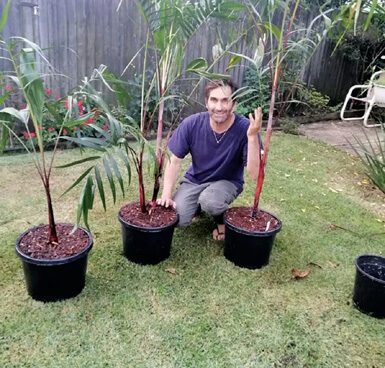
Merc had a passion for growing rare palms, earning him the moniker ‘The Germinator’
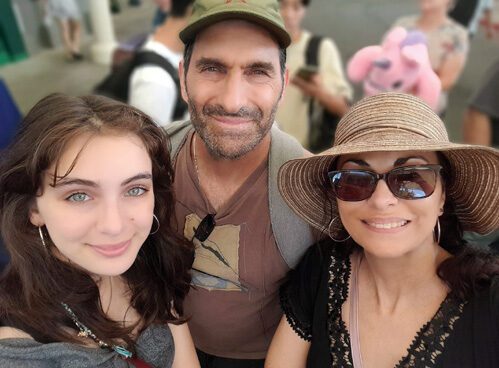
Freedom, Mercury and Maria were a tight-knit family
“I can’t forget that,” Maria cries, her body starting to shake uncontrollably, the tears running down her face. “That’s part of the reason why I’m doing all this.”
‘All this’ refers to the advocacy Maria has led through her grief to get a better shark management program in NSW. Changes have come in dribbles, despite Maria’s calls just one month after Merc’s death for an increase in shark drones and a more co-ordinated approach.
The family were very tight knit, with Merc and Maria working hard since they married to build strong foundations for a long life. They spent all their time together as they worked from their home office. A 31-year-partnership which produced Merc’s greatest ‘purpose and pride,’ daughter Freedom.
“Mercury was a wonderful husband, a wonderful person. He could just light up a room when he walked in,” Maria says smiling. “He had such a vibrant personality, and would always make me laugh.
“He just had this presence, that everyone wanted to be next to him.”
Born in Mona Vale, Merc and Mike had a great love of the ocean, Maria recounts. “They found a foam board in the rubbish dump and taught themselves to surf at Kiddies Corner, Dee Why when they were 10.
“They both got hooked and would fight over the board!” she laughs.
Merc knew the dangers of sharing the ocean with predators. In the last 15 years, he had never surfed at dawn because it was too ‘sharky,’ Maria recalls he would say. “He was very vigilant in that,” Maria states firmly. “He would not go out if there were bad conditions. He was probably the most careful. It’s quite ironic (that he was killed by a shark).”
The NSW Government’s Shark Management Program at the time Mercury was attacked involved nets at some beaches including Dee Why, baited SMART drum lines in 19 council areas, and 37 tagged shark listening stations, which relay detections to the SharkSmart app. Shark drones operated by professional pilots and volunteer lifesavers were funded for 50 beaches – but only for the peak summer season.
So in September last year, there was no drone operating at Dee Why.
“Why were there no drones between Newcastle to Wollongong in the most populated areas on that morning Merc got taken? There were hundreds of people in the water. Hundreds. And it was a beautiful sunny day. There was no rain before. It wasn’t dawn or dusk, it was 10:10am. So it’s quite upsetting when they say those things now (about shark risk factors), when it wasn’t relevant to my husband that day.”

Maria’s way of taking control in the chaos of grief started by creating a shark incident spreadsheet. As a bookkeeper, keeping track is second nature to her. There did not seem to be one central place for all the information – with shark listening stations, live sightings reported on local chats, the SharkApp and drones all working separately, feeding information to different sources, including the Department of Primary Industries (DPI) and Surf Life Saving NSW.
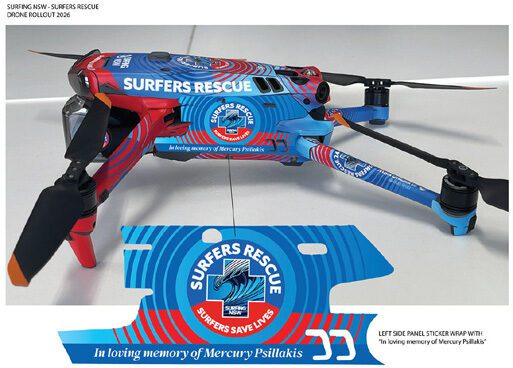
60 shark drones memorialised to Mercury were funded in May.

Twin brothers: Surf shaper Mike (right) made all the boards which Mercury used
“It seemed to me like there were too many holes in the system,” Maria says.
Maria and Mike were invited to meet NSW Agriculture Minister Tara Moriarty, some three months after Mercury’s death. “I said to Tara, ‘As well as automated drones, I want all the experts to sit on a round table. The marine biologists, shark experts, fishermen, fisheries, environmentalists – everyone.’
“Just sit together and communicate and collaborate and come up with something that’s practical, that’s viable.”
That suggestion was not followed, but the NSW Government put $2.5 million into expanded shark drone operations.
A group called A Surfer’s Voice formed, made up of board rider club presidents and community advocates from the Northern Beaches. Maria says they meet fortnightly, working on strategies needed to manage the risk. “Shark mitigation’s a complicated issue,” Maria says. “We have to consider the ocean, the environment, humans, as well as the animals.
“We can’t completely get rid of the risk, but can minimise it.”
Things really ramped up in January this year following a series of attacks by bull sharks on the Northern Beaches and beyond after heavy rain and murky waters – culminating in Nico Antic’s death. The government ploughed $4.2 million into bull shark behaviour research, Surf Life Saving drone patrols seven days a week, and more shark listening stations.
Shark surveillance drones memorialised to Mercury were funded in May, specifically for 60 board rider clubs to alert beachgoers through the SharkSmart app and alarms. At the time, Maria and Mike said: “The release of these drones in Mercury’s name is deeply meaningful to us and our family. It is an honour that recognises not only his life, but the love we continue to carry for him every day.
“There is still more to do, and this must remain an ongoing conversation. Ocean safety, shark mitigation and community protection require continued effort, continued investment, and continued collaboration, and we look forward to continuing this work together.”
Momentum seemed to be stalled, however, with gaps remaining in drone coverage, given they largely operated during the peak summer season, from 9am to 5pm. Just 13 drones operated across Sydney over winter, including three on the Northern Beaches. That is, until the horrific Great White attack on Leah Stewart. It led to calls by Pittwater MP Jacqui Scruby, Maria and Mike Psillakis for 365-day-a-year, dawn till dusk drone coverage to ensure full protection of ocean users.
Their pleas were answered when Premier Chris Minns announced on 28 June a record $122 million spend on ‘dawn till dusk,’ all year round shark drone coverage, from Palm Beach to Cronulla. As well as trialling two new AI systems over summer, ‘harnessing automation’ – just as Maria had been calling for. There is now also talk of a shark mitigation ‘summit’ of experts.
“Look, it’s wonderful this announcement about the drones, but to me it’s very upsetting because of how many people had to get hurt (for change to happen),” Maria reflects.
“It’s what I was asking for back in early November which I thought was the ultimate dream. And it’s happened. But we’re in 2026, there’s a lot more we can do.
“Everyone’s like, ‘Celebrate!’ And I’m like, ‘That’s not bringing him back,” she says, sobbing.
I ask Maria if she feels that the change would not have happened but for her voice, her advocacy. She collects herself, and answers firmly.
“Look, it was a team effort. Everyone helped. We’ve got A Surfers Voice, which includes those who I think are very vital to citizen science.”
A Surfers Voice has set up a public reporting system of shark sightings, and Maria has given the DPI her spreadsheet of interactions for their database, which she hopes will fill in the gaps. The ability of ocean users to have data so they can assess risk is crucial, Maria states. “Merc was only 80 metres from shore that day. If he had known that multiple drum lines had been triggered that morning around Dee Why, he would never have gone in the water.”
As the first anniversary of Merc’s death approaches, I ask Maria how she and Freedom will remember him.
“He was just sunshine. I know this is cheesy, but I still feel my heart belongs to him, you know? I want him to be remembered for the wonderful person that he was, and someone who was passionate about keeping people safe in the water.”
Maria is working on establishing a charity to honour her husband’s memory. “If some positive can come out of this loss, that will give some meaning to his life. He was extremely passionate about water safety. He did guide a lot of young groms in the water.”
I ask Maria if she hates sharks for what they did to Merc. “No, I don’t hate sharks. No. They’re a vital part of our environment. However, I do believe in balance. And I do think human life is important.
“We need to improve our evidence-based systems and join forces with everyone who has a vested interest in the ocean to improve things. As it stood in September, 2025 I think there was a lot more work to do. And thankfully we are going in the right direction.”
Maria admits she finds night times ‘the worst’ as she can’t sleep due to her grief, so campaigning for better shark management is a good distraction, she says, tearing up again. “I just want to prevent another tragedy and honour Merc’s life and his passion for ocean safety.”
While some would like to mark the one-year anniversary of Mercury’s death officially, it comes at a difficult time for Freedom, who is completing the HSC. “Right now, my main priority is my daughter,” Maria says. “Once this charity’s established and I have time to breathe, we will do something to honour him.”
Maria says she is forever grateful to Northern Beaches locals for their support after Merc’s death, including donating funds to help pay for Merc’s funeral. “The community has been so incredibly kind and supportive.”
She has reached out to the family of Leah Stewart to offer support – empathy with victims often missing in the discussion about shark management, with the NSW Government now considering shark culling. “I would actually just love to give her a big hug. And apologise,” she says, tears once again rolling down her cheeks. “Because not enough was done.”
The debate on ‘what to do about sharks’ has become clouded with emotion, Maria laments. “It’s overshadowing people’s compassion right now. And human decency.”
Going in the water is now off-limits for Maria – as well as the sand. She is afraid of the ocean. But more than that, the beach is a constant reminder of her husband. “Everywhere I go, he’s there. He was my protector and my rock, you know?
“I’m very lucky to have felt safe, loved and wanted.”
While it has only been 11 months since Merc was taken, and much has been achieved, Maria’s advocacy journey is not over. “I’m just a nobody. I’m first and foremost a mother. People need to understand that (victims) have loved ones. It affects a family and a community and Merc’s not just a number.
“I hope I can inspire other people to stand up and speak for what’s right. I want people to enjoy our beach with confidence, while protecting the marine environment and the species that we all love. Including our own.”
Report shark sightings: sharkdata.com.au