


Clubs don’t like to beat their own drum, but they provide crucial support to charities, sporting organisations and community groups – helping create a cultural identity for Sydney suburbs along the way.
Dealing with children who are about to pass away is a sad but essential part of Clare Pearson’s work. As chief executive officer of charity Little Wings, Clare is responsible for a team of volunteer pilots who transport critically ill children from regional areas to metropolitan Sydney hospitals for treatment.
The youngest child ever transported was newborn baby Evelyn, just 24 hours old and suffering liver failure. To give Evelyn’s family in Tumut precious time with her in the four weeks she had to live, a Little Wings aircraft flew the baby back home every few days from hospital in Sydney. “Those moments, you can’t pay for that, you can’t replace it,” Clare reflects. Which is why she is such a big supporter of clubs, given Little Wings is completely dependent on their funding to survive. Clare is adamant about what would happen if that financial lifeline stopped. “We wouldn’t be able to operate.
“Clubs are not great at tooting their own horn, but the reality is there are hundreds if not thousands of charities that are living off the support of clubs. We cannot function without that partnership.”
Under the NSW Government’s ClubGRANTS scheme, clubs can donate a portion of their gaming profits to not-for-profit community organisations, charities and sporting groups. Collectively in the 2024/5 financial year, clubs contributed just over $1 billion in gaming tax to the State Government – with the biggest haul from hotels at $1.45 billion, and casinos $203 million. But unlike hotels and casinos, which are for-profit entities, clubs are owned by members and classified as not-for-profit, meaning they channel funds back into the communities they serve.


Little Wings’ pilots donate their time to transport critically ill children to Sydney
ClubGRANTS is just one way they do this, and in 2025 over $100 million worth of projects were funded across the state, from meals for the needy, female change room facilities, to outreach for lonely seniors.
It’s why St George Rugby League Club CEO Craig Epton says clubs are the ‘soul of the community.’
“It’s a meeting point. It’s an area that people feel safe and warm. It’s a place staff know their name. And I think that aspect gets lost.”
St George’s history harks back to 1952, but it was for its ‘Taj Mahal-eske’ building which opened in 1963 that it is most famous, when it became a ‘beacon of entertainment’ in Sydney, Craig says. “It really was ahead of its time in a lot of ways, and because of that it also grew on the back of the 11 premierships of the St George Dragons back in the day.”
That rugby league team is now known as the St George Illawarra Dragons, whose wins and losses definitely influence the mood of the population, Craig jokes. “St George League’s club is probably the biggest cultural driver within our community, and the success of the Dragons sometimes dictates that.
“It’s a modern-day church, really, bringing the community together and gives everyone a true belief.”
Success starts with the young, and St George is so passionate about juniors that it funnels $1 million into youth pathways a year.
“It really is our heart. We’re now a 50% owner of the St George Illawarra Dragons, so our focus is on the juniors, at a representative and growth level.”
In practical terms, this means free registration and uniforms for 6 to 10 year olds, which in 2025 increased participation of local children – boys and girls – by 40%. “Across all junior clubs in the district, the numbers have never been higher,” Craig says proudly. St George also supports basketball, netball and soccer across the region.
“It’s our reason for being,” Craig explains. “We want to see people fit and healthy. We understand what sport does. Not everyone is going to be a Dragon and reach the elite levels. But I think anyone who’s ever played sport through their life understands how important it is to be socially active, community active, understand what a win or a loss is, understand that not everything is going to go to plan.”
While many clubs fund grassroots sport in the community – keeping costs low for families, Craig points out – it is not all they do. Revesby Workers’ Club (RWC) was formed in the 1960s specifically to help those in the community who needed support. It’s something that CEO Scott Bennetts remembers every day via a quote on his wall from the inaugural manager, who deemed RWC to be ‘the answer’ to help surrounding working class locals experiencing hardship.
“It’s our genesis, and that feeling has gone all the way through for the 60 plus years that the club has been going,” Scott states. “So it’s very important to us to continue that.”
Scott is very proud of what he feels has been the club’s largest and most impactful contribution in the modern day: Biyani House – Revesby Women’s Shelter. RWC is in for the long haul, having made a 20-year commitment to fund the home.
“Sadly, there is such a need, the house is never empty,” Scott laments. “But that’s probably one of the most impactful (projects), because it is literally not only changing lives, but potentially saving lives of people in the community and helping women and their children get through domestic violence situations.”
Some 127 women and children went through the doors from 2022 to 2024, providing 6,108 safe bed nights, Scott reports.
The club’s commitment to ending the scourge of domestic violence does not stop there. All 350 staff – including Scott – have training in how to help domestic violence survivors, and wear a purple t-shirt on Fridays as part of a ClubsNSW campaign to bring greater awareness to the issue.
It’s no secret that the funds which clubs such as Revesby and St George have to be able to make such significant financial injections into community projects come from poker machine profits. Scott is quick to demystify the often-maligned pokies. “It’s a form of entertainment, just like some people go out and eat at fine dining restaurants.


A young patient flies to Sydney with Little Wings
“(Pokies) are a safer form of gambling than sitting at home on a computer where there is no regulation, or no one looking over your shoulder, or no one able to help you. And it is a legal form of entertainment,” Scott emphasies. “And I believe we’ve got processes in place to look after people that do get carried away with their gaming.”
In fact, NSW clubs are under some of the strictest gaming regulations in Australia, including that poker machines must not be advertised from outside the venue, clear separation of the gaming area from other parts of the premises and a responsible gaming officer on duty while machines are in operation. Every poker machine at a club is registered with an externally-operated centralised computer, known as the CMS, and the activity of each machine is automatically sent to the CMS every 15 minutes. There is no hiding when it comes to poker machine profit or use.
At Revesby, pokies make up less than 10% of floor space – with no chance of increase as it is against company policy – and in the context of the whole building, is just a small part of what the club offers. “People come to the club for all different reasons,” Scott explains. “We have about 600 people a day come to the gym. We’ve got about 600 seats in our food area, probably another 400 seats in bars. We’ve got an auditorium and function space. So probably the percentage of people who come to gamble is around 10%.”
Giving back to the community is such an important ethos for Revesby, that the board decided last year to commit 10% of profits back to the community. Known as RWCommunIty – AMPLIFIED, this will be in addition to its ClubGRANTS contributions, which in 2024/5 amounted to $1.4 million.
“No one gains a profit from a club, no individual, and all the money generated does go back to the community in some form or another,” Scott states.
RWC has two long day child care centres, well utilised by working parents, as well as children’s entertainment areas like Flip Out and ten pin bowling. It’s a very family-oriented club, with a medical centre also on site. “We look after people from all ages,” Scott says.
In recognition of the fact that All NSW clubs are required by State Government laws to ensure responsible gaming in their venues, Revesby has a full-time compliance manager and takes its remit very seriously.
“It’s a genuine attempt to be able to operate with integrity,” Scott declares. “At the end of the day, I’ve got a responsibility to the board and the membership to make sure that the brand is solid.
“Even if it costs us revenue, I’d rather stand behind our product with integrity than take cheap, easy wins. I’m not alone in the way we operate. That’s pretty consistent within club properties.”
Scott says that while there are those who are ‘anti-pokies’ in society, ‘there are a lot more people in our community who love their club.’
“They love coming in, being part of the community. And I’m sure a lot of our members would be happy to put forward the positive benefits that they receive from the club.”
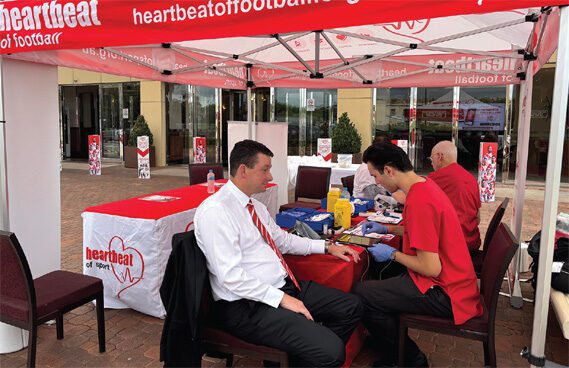

St George CEO Craig Epton getting his heart checked by Heartbeat of football which operates at sport-ing events – local and international
For Little Wings CEO Clare Pearson, clubs really do know their communities well. “Clubs are so committed to community that literally everything they do centres around ‘Why are we doing this, and how does it reflect in community and support the growing needs we see outside of the club?’”
Money which Little Wings receives from NSW clubs is used to pay for fuel and maintain Little Wings’ fleet of five aircraft which transport children from regional areas into Sydney, and back home. Most of the charity is run by volunteers, such as the nearly 100 people from south-west Sydney who perform essential tasks such as driving families from Bankstown Airport to hospital for treatment and appointments.
Just over 50% of children who use the service have some form of cancer, and they may use the service for years, Clare says. The free service is not just limited to flights, but practical things like car seats and prams on arrival in Sydney – as well as food vouchers, clothing or school supplies if needed. “We are just trying to give them that wraparound support and ease some of that journey, and the things that might be mounting in their mind,” Clare states.
“We really are part of the fabric of that child’s journey. We work in the background quietly, but are an important part because families can’t do this on their own.”
Yet additional restrictions and requirements made by the State Government over the years to ClubGRANTS has reduced the funding pool for Little Wings, Clare says. Two councils, who administer the program for the government, have already told Little Wings they are no longer ‘suitable’ for a grant as they don’t service the local community.
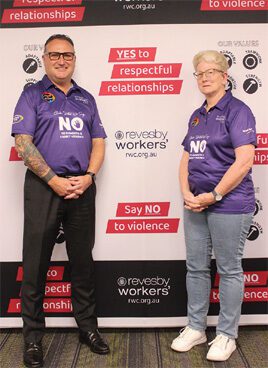

Scott Bennetts of at Revesby Workers’ was one of the first club CEOs to implement the Purple Friday campaign against DFV
“The problem with that is Little Wings wouldn’t be eligible anywhere if that was the rule, because we don’t have a base in regional locations,” Clare says. “But here in Sydney, all our volunteers are from the city. Keeping our volunteers trained and supported and giving that sense of purpose takes a lot of energy.
“On top of that, if we don’t move those children in and out of hospital promptly on discharge, they stay in the hospital and block local beds which does have an impact on the local community.”


Clubs – selected contributions 2024/25
Revesby Workers’ Club: $2.2 million (total)
Local grassroots sport — $212,188
Mental and physical wellbeing programs — $156,738
Disability support — $103,419
Education (schools) — $174,417
St George Leagues Club: $1.4 million
Catholic Care HOPE program — $51,000
Be Unstoppable Foundation — $24,000
What Ability — $30,000
Heartbeat of Football — $28,500
Fair Fight Foundation — $20,000
Any reduction in funding is ‘really scary for us because if (it did stop completely), we wouldn’t be able to operate.’
“People see clubs as just running pokies, but they also do a lot of great work and support so many of us in the community,” Clare says. “And to think that this program could be taken away or reduced or halted, will have a dramatic impact on so many (charities) that really need it to thrive and continue to operate.”
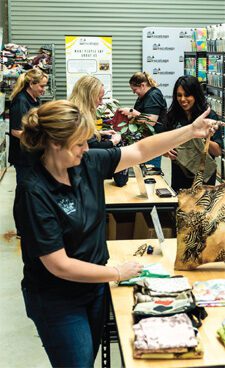

Club workers pack Escabags
For the St George and Revesby club CEOs, community support is not just about donating money. Staff regularly contribute their time with various charities; at RWC, staff help pack Escabags, ‘escape bags’ for women and children fleeing domestic and family violence. And STG’s Craig Epton says he is ‘blown away’ every time he puts an apron on at The Kogarah Storehouse, which provides food relief to needy families in the community. “I’m just absolutely blown away every time I go up there with what they do for the community for such little amounts. And that’s the ClubGRANTS program all the way along.
“I really do believe clubs understand their communities the best and understand where those pain points are and what they can do,” Craig declares. “And I know everyone that we support, we follow up, and get involved where we can.
“The people that we know do magic, and we encourage them to do more because you see the really best of community when you get involved.”
FOR MORE INFORMATION
Find out how to apply at: clubgrants.com.au


