


When Monica Rani Rudhar was a little girl growing up in Green Valley, south west Sydney, she thought she could never be an artist. Now she has won Australia’s richest women’s art prize
At 31, Monica Rani Rudhar has just reached a milestone that all professional artists strive for in their careers. In May, Monica won the prestigious $35,000 Ravenswood Australian Women’s Art Prize, competing against 1,750 entrants. Started by the Gordon school a decade ago, the Ravenswood prize is Australia’s highest value art prize for women, placing it firmly on the artistic landscape of the nation.
At the awards night, Monica said she was ‘blown away’ when her ceramic rendition of oversized Indian jewellery,
When Both Shall Meet, took out the top prize, the professional artist category.
“I feel so validated in my practice,” Monica told the audience at the opening night. “I grew up in Liverpool to migrant parents and never thought I could be an artist. It felt so unattainable and privileged. As I stand here, I feel like I’ve made that young Monica so proud.”
The work is a nod to her Indian heritage, which the judges praised for being ‘a monument to cultural identity and the intimacy of love between mother and daughter, husband and wife.’
“Being an artist, it’s not an easy road and it just made me feel like all that work was worth it,” Monica told me when we caught up after the awards night.
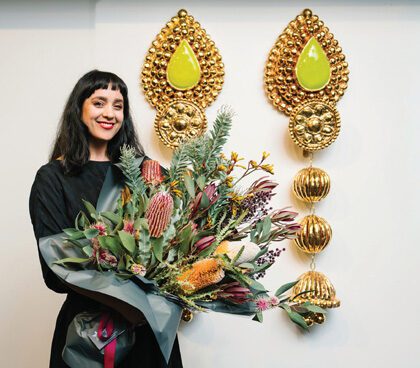

Monica at the Ravenswood Australian Women’s Art Prize with her winning entry, When Both Shall Meet. Right: A new installation, Bells in My Ears, between the entrance of the two Scape towers at Scape Lachlan on Anzac Parade. The work has 20 bronze bells installed on site
“All the struggles and the questioning and the doubts around whether this is the right thing to be doing.
“I felt very seen. It’s a very big milestone for my career.”
The child of an Indian father and Romanian mother, Monica grew up in south west Sydney with no art in her life at all. But she had a connection to her Indian heritage through the earrings she was gifted at birth, as is customary in that country. With no Indian family in Australia, the jewellery was all she had to connect her to her father’s homeland. “This place became mythological, through stories and tales,” Monica recounts. “The earrings acted as ciphers or sacred objects, almost.”
Passed on through the female line, the jewellery becomes a lineage for Indian women, Monica explains. When Monica became an artist, she wanted to recreate their gravity and meaning in her life. “I really liked this idea of turning small miniature sculptures made for your body and magnifying them.”
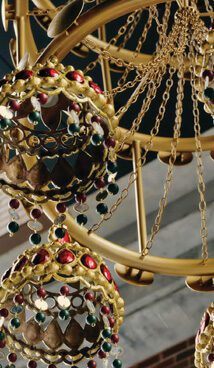

The result has been a series of huge ceramic pieces exhibited in galleries and spaces across Sydney and New Zealand, including the Rememory exhibition at the Biennale of Sydney (Penrith Regional Gallery) this year, and the Museum of Contemporary Art Australia in Sydney.
The pieces are made from terracotta, in a nod to India where the material is commonly used in homewares, and can take two months to make due to the long drying process. Monica glazes and fires each piece three times, using gold lustre to achieve a ‘super gold and shiny’ look.
It’s not a perfect process, with Monica revealing, ‘I’ve had so many breakages, I’ve had explosions, and it’s been heartbreaking.
“It teaches you that the work is not guaranteed. There is a chance that it could come out broken.”
The artist, now based in the Inner West, said it was ‘exciting’ that more ceramics are now featured in contemporary art. “Things are happening very quickly and I’m making a lot of work and producing a lot. So after winning (the Ravenswood prize), I was able to take a bit of time to reflect on how far I’ve come and how my ideas have developed over this time.”
She plans to put the Ravenswood prizemoney straight back into her practice, ‘to feel like I’m not limited financially with my materials.’ Gold lustre is made from real gold and costs $400 for 25 grams!
As for the importance of the Ravenswood prize in Australia, Monica is candid. “Through art history, women have very much been excluded from the conversation.
“To have a prize that is solely dedicated to women, and to showcase women’s work…it’s so important. It’s also important for emerging artists as well, because it’s hard to get your name out there.
“It’s got a legacy. A lot of the winners have really developed in their practice. I hope it continues for many years to come.”


