


Australian freestyle aerial skier Danielle Scott is eyeing the podium at Milano Cortina, hoping to make her fourth Winter Olympics the best yet. Tamara Spray reports.
Hitting a downward ski slope at 70km/h, flying 10 to 15 metres in the air and perfecting complex tricks, flips and multiple twists is a tough ask – but freestyle aerial skier Danielle Scott makes it look like a breeze. And while Danielle could just as easily be surfing a wave on Freshwater beach, this snow sport is the one for her.
“I can’t imagine doing anything else,” Danielle, 35, says. “I love the challenge of it. I love being able to push myself mentally and physically. I literally love what I do.”
At the time we chatted back in December, Danielle was in the middle of back-to-back qualifying events leading up to February’s Winter Olympics in Italy.
Despite arriving in China at 1am the morning we spoke, Danielle was bubbly and gracious with her time, with not a hint of tiredness. The seasoned athlete who grew up on the North Shore and Northern Beaches is in a unique position as just one of a handful of Australian athletes expecting to compete at four consecutive Olympics (at time of writing the team had not been finalised).
“It’s a pretty big honour,” she says. “A lot of people dream of just going to one, and when I went to my first Olympics, that was a childhood dream come true. So to think that this is my fourth is pretty special. I’ve dedicated my life to being an athlete and I love what I do.”
It’s a grueling schedule for the Olympian, who has been travelling constantly for the last 12 months. December saw Danielle compete in Finland and China, and she has just been in Canada and the USA – with a quick trip back to Sydney for Christmas in between. The hard work has paid off, as Danielle is coming into Milano Cortina armed with a World Cup gold, won in January at Lake Placid, USA. She backed it up with a bronze medal the following day, taking her career tally to 27 World Cup podiums and boosting her hopes for an Olympic medal.
“It’s kind of nice because you get on a roll,” she says of the consecutive events. “But changing time-zones is pretty tricky. Going from Finland to China and then heading off to Canada, you’re back-to-back changing time zones. Sometimes the last person standing (is the one) who dealt with that the best!”
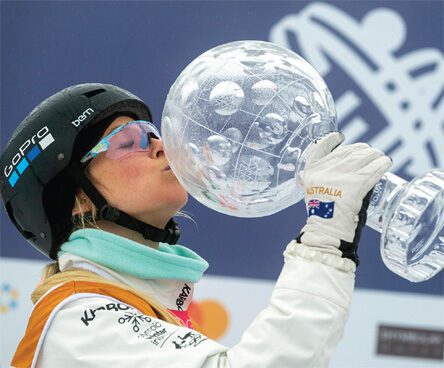

Danielle’s second consecutive FIS World Cup triumph in March 2024
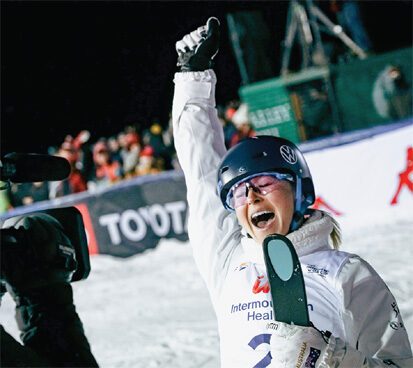

The athlete celebrates at the Deer Valley finals
It’s all in the lead up to the big event – the Winter Olympic Games Milano Cortina, which runs from 6 to 22 February. Despite having competed at the last three Winter Olympics: Sochi 2014, PyeongChang 2018 and Beijing 2022, Danielle is yet to take home a medal. “It’s one of the things that I haven’t achieved yet and have been capable of, so I’m definitely looking for a medal,” she says. “But I think at the same time, and with it being my fourth Olympics, it’s about leaving a legacy in the sport and inspiring more women to do triples.
“A medal is obviously icing on the cake, but it’s also about leaving that legacy in the sport.”
In aerial skiing, ‘triples’ refers to the triple kicker (the ramp the athletes launch from), the largest jump in the sport where three somersaults and various twists are performed. The athletes then aim for a smooth landing on a 39 degree landing slope, making it look ‘like you just stepped off a curb,’ Danielle explains.
She admits there’s nothing quite like competing at the Winter Olympics and recalls her first Games in 2014. “It was pretty cool. I think I was just so starry-eyed and amazed at it being the world’s biggest sporting stage.
“It’s just this unbelievable feeling of pride to represent your country. I think for winter athletes too, we are such a small team compared to summer Olympians. With a lot of the winter sports, our bodies are on the line. It takes a lot of guts. We risk a lot. It’s such high speeds on icy slopes – we have respect for each other out there!”
The dream started young for Danielle – at age seven she became the youngest athlete to receive an Australian Institute of Sport scholarship. She went on to compete at a national level and was training 40 hours per week. “I retired at 13, which in the gymnastics world is still young. I always had dreams of going to the Olympics and I didn’t get as far as I wanted to (with gymnastics) so I was looking for other challenges.
Ironically, (Australian aerial skier) Alisa Camplin had just won gold at the 2002 Winter Olympics and Danielle was given Alisa’s book by her mum. “Alisa was a gymnast so I think Mum was hinting that this could be another opportunity for me,” she says.
At the time, Jacqui Cooper, a five-time Winter Olympian aerial skier was recruiting young athletes to the sport, and after a meeting with her parents and Jacqui, Danielle joined the aerial ski training program – despite having never skied before!
“I didn’t really know much about this winter sport when I started. I grew up on the Northern Beaches, I’d never seen it live. I’d only watched videos, so it was a funny thing to commit to, but I saw the opportunity and went all in and never looked back.
“I was pretty hungry to make it to the Olympics!” she laughs.
The hours Danielle spent training at the (former) Cromer Gymnastics Club set her up well for aerial skiing she says, as ‘it’s easier to teach a gymnast to ski than it is to find skiers who can flip.’
Once recruited, Danielle went into a fast-track program, learning to ski at Mount Buller, Victoria, and then Utah in the USA, before making the gradual progression to aerial skiing.
Jumps are perfected on a 37m tall water ramp with an extra- deep Olympic-sized swimming pool underneath, before they are practiced on the snow.
“Doing a big jump on snow for the first time, you get scared and there are nerves, but I think having the gymnastics career gave me valuable body awareness and I trust my ability with all the hard work I put in.”
Training for a winter sport in Australia has proven difficult at times over Danielle’s long career, but she says the opening of the water ramp at the Geoff Henke Olympic Winter Training Centre in Brisbane in 2020 was a game-changer. It meant she and her fellow athletes no longer needed to hustle for practice time slots at training sites in other countries. “I used to spend eight to 10 months of the year overseas and it was pretty tricky,” she says. “You really had to commit your whole life to the sport. You couldn’t really (get) work overseas and it was tough.


Danielle with the Australian team at the FIS Freestyle World Championships in March 2025
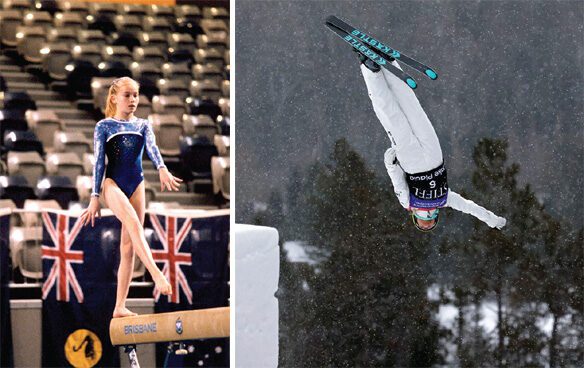

Danielle was a skilled gymnast in her younger years (left); Her bronze winning World Cup jump at Lake Placid in January (right)
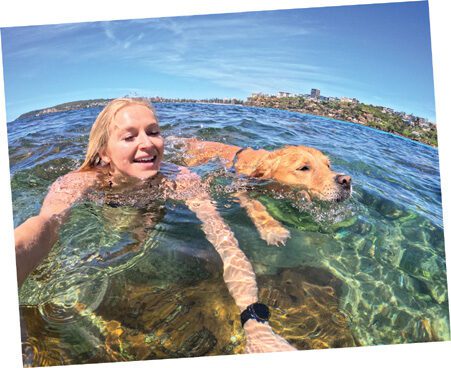

Danielle spends some downtime at Boomerang Beach with her dog, Henry
“As much as I love travelling, it was exhausting. Now we can train all year round. It’s huge for us.”
She adds that it also ‘opens doors for the future of the sport.’ “We’ve got a lot of young guns coming through, which is exciting now having the water ramp in Brisbane. We can actually train on home soil and it’s an opportunity for younger athletes to take this sport on,” she explains.
The future of the sport, and young athletes, has also seen Danielle advocate for awareness around concussion. “We do hit our head on a regular basis and there’s never been enough research or attention to it,” she says. “There’s just no data out there.”
Danielle and her medical team have come together to change that. “I’m currently the first athlete to be recording data through an impact-sensitive mouthguard,” she says. Her aim is to collate data to be used for future research into the impacts of the sport on the body.
She has also instigated for neck strength to be implemented in all development athlete strength and conditioning programs using the Iron Neck device, helping to keep young athletes coming through better prepared to deal with the physical impacts of the sport.
Apart from her usual training schedule, Danielle loves to indulge in adrenaline sports, a passion she shares with husband Clark Denning. The couple, who have known each other since they were teenagers, were both surf lifesavers at Avalon and Whale beaches, and enjoyed surfing together. They wed in June 2024 and have made Boomerang Beach on the NSW Mid-North Coast, their home.
Together they ride motorbikes, go mountain biking, love to snowboard and enjoy spending time with their dog, Henry. “I love to put my body in all situations and think of it as good cross training because the more exposure you have, the better you are at reacting and handling any situation,” she says. “I chase adrenaline for the fun of it, and also for the strategic side of it.”
Cheering her on in Livigno, Italy, where the Olympic aerial skiing competition is to be held, will be family and friends. And what weather conditions will Danielle be hoping for? “A minus seven-degree temperature, clear skies, good light – not flat (cloudy) light – and no wind would be ideal!” she says.
Leading up to the Women’s Aerials qualifying on 17 February, Danielle will be maintaining her focus. “I think that’s the hardest part of elite sport and being at the top end of it. Obviously, you have to be physically prepared, but that’s easier the longer you do it. And it probably is more the mental side. It’s keeping a level head and knowing what works. If it gets too tricky or I’m not sure what I should be thinking, I just go back to the feeling I get when I’m in the air.
“When you do a nice jump and you land it, it’s just the best feeling in the world! I know I can’t be an athlete forever so I think I’ll be addicted to that while I can.”
The Winter Olympic Games Milano Cortina will air on Channel 9, 9Now and Stan sport from 6 to 22 February. Watch Danielle in the Women’s Aerials starting 17 February.


