


Water buckets and axes were tools of the trade for firefighters in the 1870s
Early this summer, fire authorities were already warning of an ‘above average’ fire season in NSW. In North Sydney, a highly urbanised area with limited bushland, domestic and industrial fires generally pose a higher risk than major bushfires. More than 25% of the fires attended by Fire and Rescue NSW (FRNSW) during 2024/25 were structural. FRNSW is the busiest urban fire and rescue service in Australia, working alongside the NSW Rural Fire Service (RFS), the world’s largest volunteer fire service, to tackle bushfires.
In the early days of European settlement, firefighting services were not so coordinated. The prevalence of timber homes, combined with open flames for heating, lighting and cooking, made domestic fires a significant hazard in the 1800s. From the mid-19th century, volunteer and insurance company brigades provided Sydney’s fire protection.
The first fire brigade in North Sydney was formed in 1877 by volunteers from St Leonards, based in Mount Street. Their rudimentary equipment consisted of a hand-drawn cart, buckets of water and axes to break down doors or walls. Sydney’s disparate brigades were unified by the government-run Metropolitan Fire Brigade (MFB) in 1884. All brigades were required to register with the Fire Brigades Board and meet professional standards. The board subsidised the St Leonards Volunteer Fire Company, which began to use East St Leonards Town Hall on Alfred Street, Milsons Point, as a branch station from 1885.
By the early 1890s, the newly created municipality of North Sydney needed a permanent, central fire station. North Sydney Fire Station opened in 1895 on Walker Street, with The Australian Star newspaper declaring that ‘The Shore can now boast of a thoroughly equipped fire station, manned with capable men and replete with every modern contrivance for fighting the fiend of flame’ (31 May, 1895).
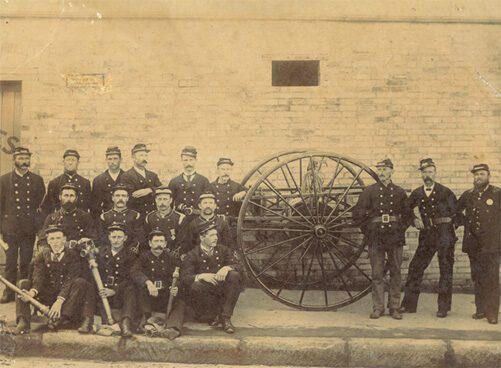
St Leonards Volunteer Fire Brigade, c1877

Neutral Bay Fire Station c1927
The station was designed by Charles Hellmrich in the classical Italianate style, common for 19th century public buildings. It was equipped with a manual engine, capable of pumping 200 gallons a minute, and two horses. Living quarters for officers and men were constructed on the first floor.
To meet the growing demands of the district, new fire stations opened at Crows Nest in 1907 and Neutral Bay in 1908. They were among the last stations to be built to the design of the government architect Walter Liberty Vernon, in the federation arts and crafts style. From 1910, motorised engines replaced horse- drawn vehicles to carry more firefighters.
Despite some improvements in efficiency, firefighting remained an arduous job. In the 1930s, North Sydney firemen were working 84 hours a week, with four men on a shift. By 1950, hours of duty had been reduced to 56 hours per week, with 60 firemen serving the municipality.
Crows Nest Fire Station became the primary station for the North Shore from 1940, and the Walker Street site ceased operating in 1945. The former North Sydney Fire Station is a rare survivor of the high-rise office boom of the 1960s and 1970s. It was converted to a restaurant and bar in 1971 and continues to operate as the Firehouse Hotel. The 50-storey tower built above the fire station, designed by Fitzpatrick and Partners, opened in 2023 as North Sydney’s tallest building. Crows Nest and Neutral Bay fire stations are still North Sydney’s firefighting frontline, managed by FRNSW.
Historical Services, North Sydney Council