


If you are impacted by domestic or family violence visit 1800RESPECT.org.au or call 1800 RESPECT (1800 737 732). For immediate assistance, please call 000
Coercive control has been a criminal office in NSW since July 2024. Two years on, and with the 16 Days of Activism against Gender-based Violence approaching, how much of an impact has the legislation made? Aoife Moynihan reports.
Using abusive behavior towards a current or former intimate partner with the intent to coerce or control them is known as coercive control (CC).
The NSW Domestic Violence Death Review Team found that in 97% of intimate partner domestic violence homicides, the victim had previously experienced coercive control.
The NSW CC criminal offence targets patterns of abuse used to intimidate, threaten or control someone and only applies to behaviour after 1 July 2024.
A report released in September by the NSW Bureau of Crime Statistics and Research (BOSCAR) found that in the first two years up to June 2026, 682 incidents of CC were reported, with harassment, monitoring or tracking accounting for 59%.
Sixty percent of CC incidents were accompanied by another type of offence, mostly stalking and intimidation, domestic assault or sexual assault. Almost half of the victims had a prior history of domestic violence recorded by police.
Of the 682 reports, 42 charges were laid, with 10 finalised in court, six withdrawn by the prosecution and four proven after a guilty plea. Two imprisonment orders, one intensive correction order and one community correction order with supervision were issued.
Vincent Hurley is a professor of criminology at Macquarie University and a former police detective. He is also an investigator with the Australian Research Council for the Elimination of Violence against Women.
His three-minute intense lecture at Federal and State politicians on ABC’s Q&A program in May 2024 concerning violence against women was viewed over 22 million times on social media.
“There was a buildup and expectation, me included, that this would be earth-shattering, really groundbreaking legislation that would really tackle violence against women and children,” Dr Hurley told NL. “I don’t think that’s turned out to be the case.”
Dr Hurley said that being the first legislation of its type in Australia, nobody knew what to expect.
“It’s very labour-intensive for the police to retrospectively find all the evidence, whether through bank records, SMSs, or CCTV to try and put together a narrative of a woman being coerced.”
Dr Hurley said police were ‘still trying to get their heads around it’ and police in the metropolitan areas would come across more CC and have more knowledge and experience than those in rural areas.
“Victims are disappointed when they go to the police because the police sometimes don’t understand it. And there’s a direction by the commissioner that only detectives are allowed to investigate it because it’s such a long investigative process,” he said.
“It’s hard to prove. If police don’t think there’s enough evidence, they would find it easier, and I don’t mean this in a negative way, to charge an offender with stalking because they are more assured of getting a result at court or a guilty plea.”
Dr Hurley said that we’re not going to have a clear picture of the parametres of what is meant by coercion until it has been challenged in a higher court.
“There will come a time in the next five years when someone is found guilty of coercion and they will appeal it, that will then go to the superior court. It could be the Criminal Court of Appeal or the Supreme Court in NSW,” Dr Hurley said. “And then case law will clarify aspects of what coercion is.”

Dr Vincent Hurley, criminologist and former police detective

Yvette Vignando, CEO Mary’s House
Narelle Hand is CEO of the Northern Beaches Women’s Shelter, which has been providing crisis accommodation for women and children for 16 years. In the last financial year, they supported 173 women in accommodation and had to turn away 456.
Ms Hand told NL that they were seeing more CC, with a lot of financial and psychological abuse on the Northern Beaches.
She said there’s a power imbalance that comes with financial CC that means that women don’t have access to funds to get legal support, and it takes about six weeks to organise legal aid.
“We’re seeing more people being subjected to systems abuse, where they don’t have equal rights to access certain levels of support because they don’t have the funds,” Ms Hand said. “How can you compete with someone who’s got a barrister that costs $8,000 to represent them when you’re waiting for your legal aid application?”
Ms Hand said that not being able to provide evidence from time prior to the CC laws taking effect made it difficult as people might have ‘20 years of historical evidence that can’t be seen.’
“We’ve had some successful outcomes around people being charged and it sends a very good message. But when you look at some of the cases that have gone through, it really is that there’s been CC along with other offences or it’s been financial CC with a clear pattern of evidence you can see,” Ms Hand said.
“It’s difficult to create the level of evidence when a lot of CC is psychological abuse. The financial abuse is the one that you can see the most. But, the psychological harm of coercive control, the psychological injuries are ongoing.”
People who are experiencing CC are often not aware and the control frequently goes unnoticed by victims. One of the signs is gaslighting, where the victim is made to believe it is they who are the problem because that is what they’re being told by the offender.
“It’s a persistent, repeated, controlling behaviour that is usually identified by someone else who might say, ‘that doesn’t sound right, that doesn’t sound like an equal relationship.’ Somebody identifies some red flags you might not be aware of,” Ms Hand said.
“You might think he’s caring, but you’re told ‘it’s controlling, you shouldn’t have to tell him where you are at all times, he shouldn’t have access to your phone, tracking you and asking where are you now?’ when (you are) with your friends,” she added.
Yvette Vignando is CEO of Mary’s House based on the North Shore, a not-for-profit that’s been providing services for women and children escaping domestic and family violence for 10 years. They’re opening a second refuge in 2027, doubling their capacity.
Ms Vignando told NL that CC was frequently used in the court system and that it was a ‘very tricky’ situation.
“If the perpetrator has the means, whether or not children are involved, he will use the court process to extend his control and abuse the victim survivor. The family court’s very aware of this and they have a lot of training for judges and registrars around what’s called systems abuse,” Ms Vignando said.
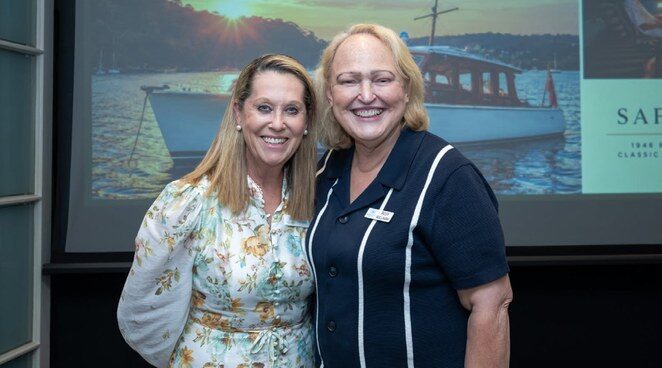
NBWS CEO Narelle Hand with Chair Rosie Sullivan

Narelle Hand with NBWS team at the Golf Day 2026
“But in the end, the law is the law. Our clients frequently continue to experience a range of distressing and traumatic experiences during family court matters and during family law proceedings.”
Ms Vignando said that when a woman sees a social worker, they sign an agreement that her information will be kept confidential. But with family law proceedings, the perpetrator’s lawyers will frequently subpoena all the records of the client.
“There were changes made to the Family Law Act last year to provide some more confidentiality to clients who seek specialist domestic and family violence services, but in our experience, it hasn’t made any difference. The lawyers for the perpetrators still do sometimes subpoena the records,” Ms Vignando said.
The client and Mary’s House can object to records being accessed but, it’s the decision of a family court registrar or judge.
“In my personal opinion, it’s a very unsafe system,” said Ms Vignando. “People should be allowed to seek support and know their records will be confidential and not accessed by either the perpetrator or their lawyer later in family proceedings. I don’t think it’s trauma informed, I don’t think it’s safe and it’s really unfair.”
A NSW Government taskforce will review the operation of the CC legislation and table a report in Parliament in July 2027.
16 Days of Activism against Gender-based Violence
25 November to 10 December annually
Visit unwomen.org
Mosman Council’s Walk for Women
27 November | 10.30am | Wear purple!
Mosman Village Green to Allan Border Oval Pavilion
Visit events.mosman.nsw.gov.au
Willoughby Council
2026 Mayor’s Solidarity Walk Chatswood
See Willougby Council website for details
North Sydney Council
Purple lit Chambers and two purple benches in Ted Mack Park
Lower North Shore Domestic and Family Violence Network:
Supported by North Sydney and Willoughby Councils
1 Minute Silence 4 Violence, Lane Cove Plaza, 3 December
Online webinar 8 December: young men, belonging, identity and healthy masculinity
See the Network’s Facebook page
Northern Beaches Walk Against Violence
Friday 4 December | 7.30am to 9am | Wear orange!
Queenscliff Lagoon to Shelly Beach
NBDVN presents – Upstander Training for Community
Thursday 26 November | 6pm to 8pm
Online workshop
Change the Conversation About the Manosphere: Understanding young men, belonging, identity and healthy masculinity
Tuesday 8 December | 6.30pm to 8pm
Online webinar
See Northern Beaches Council’s 16 Days of Activism webpage or email the network at nbdvnetwork@gmail.com