


Court can be stressful, but reporter Evren Munro met some lovely Labs in Manly that are working hard to make sure that everyone keeps calm and carries on.
Manly Local Court is a bevy of activity – lawyers in wigs racing to their hearings, police officers preparing to give evidence, and those who stand accused of crime waiting nervously to hear their fate.
Sitting patiently in court waiting rooms three days a week you will find a gorgeous Labrador with their handler. The Guide Dogs Canine Court Companion Program helps those attending Manly Local Court stay calm and receive comfort in an otherwise confronting environment.
Claire is a volunteer who brings her therapy dog Evie to Manly Local Court each week as part of the program. I’m at the court watching Evie at work, and while Claire answers questions, people walk up to her and the other volunteers to tell them just how grateful they are for the program. Strangers and staff pass by and laugh, saying things like: ‘I wish that was my job!’
It’s feedback volunteers get all the time, Claire says. “There are always so many positive stories that people have – it’s not necessarily the one person that’s patting the dog that is benefiting,” Claire explains, with Evie lying on the floor by her feet, tail wagging and eying the treat bag. “(The dogs) can affect the whole environment and atmosphere. It just diffuses (any tension).”
Claire herself works part time, and uses her free Wednesdays each week to volunteer, finding the combination of paid and volunteer work much more fulfilling.
“I used to volunteer (at a children’s hospital) with my older black lab, Lexi, but as she got older, she told me she was ready to retire. So, I was looking at options to volunteer with a dog and I came across the companion program.”
Run by Guide Dogs NSW/ACT, the program sends specially trained, uniformed dogs to select courts around NSW, where they get pats, cuddles, and affection from those who need it. The dogs (and volunteers) are easily identifiable by their orange vests and shirts, and Manly Courthouse has a sign out front announcing the presence of the furry staff.
“When Guide Dogs got in touch and said there was a spot available to participate in the program here at Manly, they said (they would find me a dog),” Claire explains. “They have quite a few therapy dogs coming through (who don’t become guide dogs) and asked if I would be able to provide some temporary holiday care for a dog.
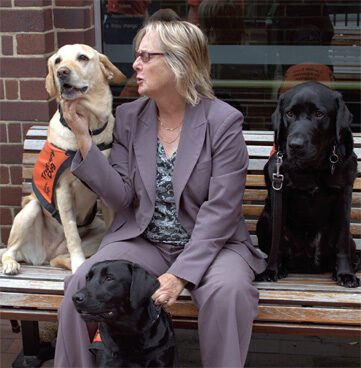
Anya, Evie (bottom) and Fella with Fiona ‘the Dog Whsiperer’ from Legal Aid
“As it happened, that dog that we were looking after was Evie. I asked Guide Dogs if there was any way that we could keep her and that she could become the court dog.
“And they said ‘Absolutely, no problem. We think she’ll be great in the court program.’”
The program has multiple routes for prospective volunteers to join, but most common is to directly adopt dogs trained by Guide Dogs. Therapy dogs go through the same intensive training as guide dogs, after which they’re evaluated to see which pathway would suit them best – from guide dogs for the vision impaired, to therapy dogs, and even ambassador dogs who go out to raise awareness for the Guide Dogs charity. Therapy dogs are trained to be around people, and carers are required to treat them as part of their families and spend as much time with them as possible.
“They know what’s needed of them. They’re here to give out the love.”
Claire Cregan
“They have all undergone a huge amount of training to get to this point. So they’re extremely, extremely well-trained dogs.”
As for an average day at the court, Evie’s workday has a simple structure. After greeting the court staff and Legal Aid lawyers on arrival, she goes around the court waiting rooms to check on people who may need her, giving attention and kindness wherever she can. Sometimes, she will be called in specifically to assist someone who is particularly anxious or distressed – these requests can come from court professionals or police who identify where Evie is most needed.
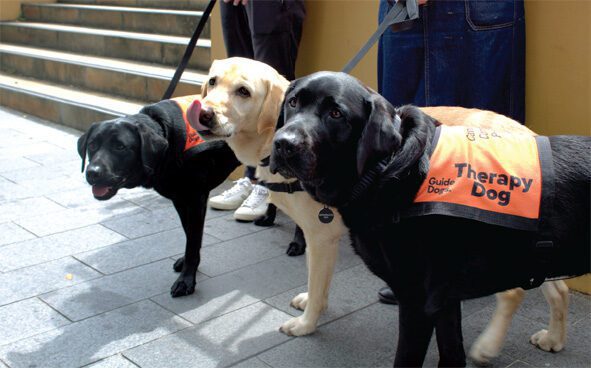
The eye-catching orange vest is the proud work uniform for the therapy dogs
“She’s got intuition to go to the people who need her. And I’m not alone in that, I know that a lot of the other volunteers say that their dogs do exactly the same,” Claire says. “They know what’s needed of them. They’re here to give out the love. (Evie) is very well suited to that.”
Claire says that as soon as the court uniform is brought out each week at home, Evie gets so excited she follows her around the house. Like work for humans, it’s a big load.
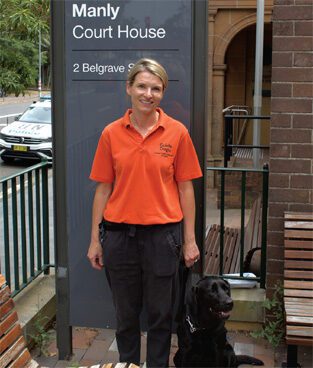
Claire says Evie gets incredibly excited when the orange vest comes out
“It is a bit tiring (for her),” says Claire. “To be honest, after court, she’s pretty tired and just loves a good snooze.”
Claire and the other volunteers love the program and would love to see it expanded into more local courts in different communities.
Fellow volunteers Leanne and Rick, with their dogs Anya and Fella (who is also an ambassador dog, with his own webpage and email!), were approached during the photoshoot and complimented on how well the canines helped those who attended court. Court staff know the dogs and their owners by name and make sure to greet them, and people waiting outside the court visibly relax when they see the dogs’ tails wagging, waiting for pats.
“There are tangible benefits to the court users, the victims of crime, the staff that work in the court, and really everyone that is involved in the court process,” Claire says. “The program can only benefit more and more people if it’s rolled out to more courts.
“People only really know about the federal program, but the local ones are just as important. Just seeing the impact that it makes is hugely satisfying.”
Evie agrees. “Woof!”