


This month’s Youth Week and Earth Day both call for collaborative thinking and bold action to protect our planet. Catherine Lewis meets the youth environmentalists in our community who are leading the charge.
In Warriewood, 23-year-old former Pittwater House student Jack Rowland, a member of the Youth Climate and Health Alliance Leaders Council, is leading the charge towards a cleaner, greener future. Described by Pittwater MP Jacqui Scruby as ‘exactly the kind of young leader who gives us all hope for our future,’ Jack has used his own health struggles to draw a strong connection between human health and environmental health.
“Growing up in Warriewood, I was surrounded by the ocean, but my environmental awareness developed later,” Jack tells PL. “I moved to the USA at age 11 and living in Las Vegas, surrounded by desert landscapes, helped me appreciate the beauty of nature. Each visit to Sydney deepened my gratitude for green spaces, trees, and coastline.” At the age of 12, Jack was diagnosed with Becker Muscular Dystrophy, a neuromuscular condition, causing a renewed focus on health and nutrition and sowing the seed for an enduring passion for the impact of nature on health.
“I used my experience of being diagnosed with a degenerative condition and the denial I had to overcome as an analogy for the way leaders must confront climate change with honesty and urgency,” Jack says. “I presented a letter in person to Matt Kean, chair of the Climate Change Authority in support of the Federal Wellbeing of Future Generations Bill 2025.” Jack received a Community Recognition Statement from the NSW Parliament for that advocacy work and aims to continue to ‘build my skills in public health so I can contribute meaningfully to improving people’s lives.’
Jack completed a Bachelor of Human Sciences, and is currently completing a Master of Public Health and says his ‘commitment to climate and health has strengthened.’
“I am currently completing a Climate and Health student placement at Westmead Hospital, alongside co-leading the National Mentoring Program for the Public Health Association of Australia. Through this work, I help elevate youth voices and contribute to national climate and health conversations,” says Jack. “Young people bring creativity, fresh perspectives, and bold ideas. We are often closest to the long-term consequences of today’s decisions, which gives us both urgency and motivation.”
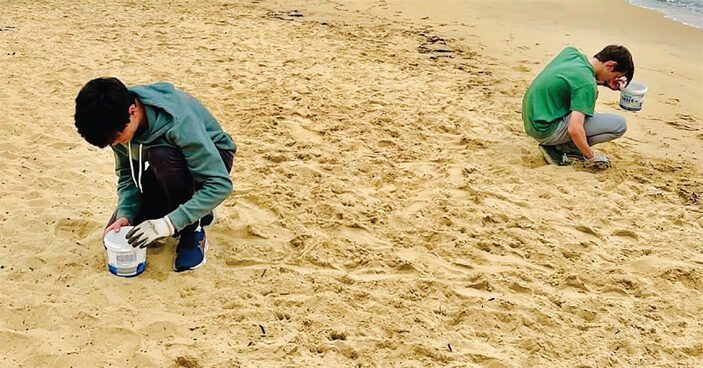
Wastebusters Sydney encourages people of all ages to take part in their beach cleanups
It all started with biologist Rachel Carson’s book, Silent Spring. In the smog of the 1960s, as fossil fuels exploded to power a booming car industry and pesticides clouded farmland, pollution was positive, prosperous, a sign of thriving industry. Carson flipped the script, warning of health and environmental impacts and sowing the seed for Earth Day – now celebrated each year on 22 April by more than one billion people across 192 countries.
As the collective power of Earth Day has led to landmark legislation across the globe – from the US Environmental Protection Agency to the Clean Air, Clean Water, Endangered Species and Marine Mammal Protection Acts – it also serves as a platform for local, community-driven action. In Australia, it inspired the Nature Repair Market Scheme, a voluntary national biodiversity market scheme which encourages people and businesses to invest in projects that restore and protect the natural environment.
This includes planting trees on farmland, re-establishing vegetation along waterways and encouraging the use of biodiversity Indigenous knowledge – ‘key tools’ to address the crisis, says Biodiversity Council director James Trezise, warning that Australian nature is ‘experiencing a precipitous decline.’ Earth Day has also fostered a culture of volunteerism, with organisations like Conservation Volunteers Australia, springing up.
As this year’s Earth Day announces its ‘Our Power, our Planet,’ global theme, it’s clear that collective action is where it’s at. Closer to home, National Youth Week calls for the same – a coming together to propel positive change in our communities. Hafsa, 15, a member of the 2026 NSW Youth Advisory Council, says that her creation of this year’s theme, ‘Dream. Dare. Do,‘ encourages creativity and courage, inspiring young people to dream big and take real steps to make those dreams happen. Youth Week – 16 to 26 April this year – inspires people aged between 12 and 24 to share ideas, showcase talents, attend live events such as Open Mic nights and advocate for transformation within their local area.
Daring to dream big is exactly what Northern Beaches Secondary College Manly Campus Year 11 students, Jiayi Fang and Leron Pinco and Queenwood’s Year 10 student, Olivia Cunningham are doing.
Jiayi volunteers for organisations including Kids Giving Back and Zooniverse. She also participates in local Bushcare programs, the Ku-ring-gai Net Zero Action Collective, and Amnesty’s Climate Justice Working Group. She is an ambassador for Ocean Youth and received the 2024 Upper North Shore Young Volunteer of the Year. Leron and Jiayi are co-presidents of their school’s Environment Committee, running a recent school-based Youth Leading the World event and are working on implementing composting, chickens and waste-free Wednesdays.

Leron from Wastebusters Sydney taking part in a cleanup on the Northern Beaches
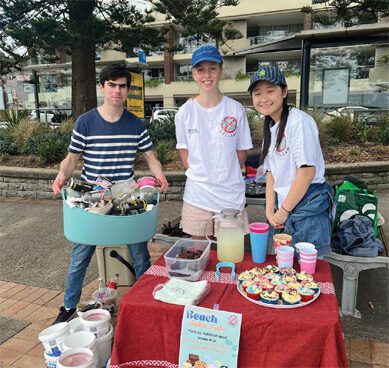
The Wastebusters Sydney team leading the cleanup at Manly Cove
The trio’s biggest project to date is their non-profit, Wastebusters Sydney, which promotes environmental action through education and community clean-ups across the Beaches, most recently at Collaroy. The team swap baked goods for rubbish, in a bid to encourage helpers of all ages to take part, focusing on cleaning waterways and creeks. “I have always been guided by the words, ‘Be the change you want to see in the world,’” Jiayi tells PL.
“The concept of Wastebusters came from the Youth Leading the World program in 2024. It opened our eyes to the impact and scale of waste issues on ecosystems and pushed us to think about what local action could look like. I always hated that there was rubbish on beaches and that there was lots of talk but not much action, so I wanted to be the person who did something. It’s not just about one clean-up and then it’s all over, it’s about building a community of like-minded individuals. Soon, they’ll realise the incredible efforts they are contributing with only one bucket of rubbish and be even more motivated,” she adds.
Olivia says that Wastebusters is something ‘I will never stop being proud of.’ “A youth-led organisation built from scratch – it has helped me in so many ways, from building a culture that encourages environmental actions to making new friends.”
The friends hope that Wastebusters expands to more locations over the coming years, as well as building partnerships with schools and youth programs. “Young people will live with the consequences of environmental damage, so our work allows us to take the future into our own hands,” Jiayi says. “We have the power to shape the culture that surrounds caring about the environment, to normalise it, to show that you don’t have to wait for government or business to take the first steps. Let’s change the mindset. We don’t have to engage in large acts, even the smallest contribution counts.”